



TLDR
- Healthcare website design in the US costs $15K to $25K for a small practice, $25K to $40K for a multi-provider clinic, $40K to $100K for a hospital, and $100K+ for enterprise health systems with multiple facilities and connected platforms.
- The biggest cost drivers that separate healthcare websites from standard business websites are HIPAA compliance requirements, ADA/WCAG accessibility, EHR and EMR integrations, patient portal development, and healthcare-specific SEO under Google’s YMYL and E-E-A-T standards.
- Development approach matters: a customized premium template runs $15K to $25K, semi-custom development $25K to $40K, fully custom builds $40K to $75K, and custom integrated platforms with EHR connectivity $75K to $100K+.
- Budget 15 to 25% of the initial build cost annually for maintenance, security updates, content, hosting, and ongoing SEO. A $35K website needs roughly $5K to $9K per year; a $100K platform needs $15K to $25K.
- US agency hourly rates range from $100 to $175 in the Midwest and South, $150 to $250 in the Northeast, and $175 to $300+ on the West Coast and in tech hubs. Total project cost depends on scope and hours, not geography alone.
Healthcare website design in the US costs between $15,000 and $100,000+ in 2026. A solo physician or small practice typically spends $15K to $25K. A multi-provider clinic or specialty group falls between $25K and $40K. Hospitals and health systems reach $60K to $100K+ when the site involves provider directories, location search, department pages, EHR integration, or patient portal access. Enterprise health systems with multiple facilities and connected platforms regularly exceed $100K.
The difference between a $15K website and a $100K website is not design quality alone. It is the number of patient journeys the site supports, the systems it connects to, and the compliance requirements it must meet. HIPAA safeguards, ADA accessibility, EHR/EMR integrations, and healthcare-specific SEO (YMYL and E-E-A-T) all add cost that standard business websites do not carry. This guide breaks down healthcare website pricing by organization type, size, development approach, feature complexity, and US region, so you can budget based on what your specific organization actually needs.
How Much Does Healthcare Website Design Cost In The U.S. In 2026?
Healthcare website design in the US costs between $15K and $100K+ in 2026, depending on the type and complexity of the organization. A small physician practice can typically expect to spend 15K-25K, while a multi-provider clinic or specialty group usually falls between 25K-40K. Larger hospitals and government healthcare institutions often have to spend $40K to $100K+, due to more underlying complexities and scope of work involved.
Apart from this, custom branding, content migration, SEO, security, and ongoing maintenance often add recurring costs that must be considered. Given how varied the costs are, it’s better to budget the healthcare website design project based on the patient journey, operational requirements, and technical needs.
What Makes A Medical Website More Complex Than A Standard Business Site?
Just swapping a couple of design elements, like the CTA button or the images, with ones related to the healthcare industry will fall flat. Medical website design costs run higher than standard business websites for several specific reasons. Below, we have explained the main factors that set medical website design projects apart from standard ones.

HIPAA Requirements: How Patient Information Is Collected and Transmitted
A medical website cannot treat patient information like an ordinary contact form submission. If it collects PHI, like symptoms, medical history, insurance details, or appointment information, it will need appropriate safeguards under HIPAA. Vendors handling PHI should also demonstrate security maturity, such as SOC 2 certification, and will need to sign Business Associate Agreements (BAAs) with your healthcare organization.
ADA Accessibility Requirements Shape the Entire Patient Experience
Accessibility is more important for healthcare because patients may have visual, cognitive, hearing, or mobility-related disabilities. A medical website needs to work seamlessly with screen readers, keyboard navigation, text resizing, captions, and other assistive technologies. Elements like medication information, appointment forms, provider profiles, and navigation must remain usable. Designing around WCAG 2.2 will help remove the barriers instead of forcing patients to find an alternative for accessing information.
EHR and EMR Integrations Make Healthcare Websites Technically Complex
A medical website often needs to communicate with systems already used by the healthcare organization. For example, clicking the “Book an appointment” button may need to display real-time provider availability and send the request into an EHR, EMR, or practice-management system. Making that work reliably requires APIs, authentication, permissions, data mapping, and error handling. Developers also need to control what patient information moves between systems and prevent unnecessary PHI exposure.
Healthcare SEO Must Account for YMYL and E-E-A-T Signals
Google treats healthcare as a YMYL (Your Money or Your Life) topic because patients rely on medical information while making health decisions. This makes credibility more important. The website should clearly identify physicians and their credentials, explain who reviews medical content, use reliable sources, and keep information accurate and secure. Strong E-E-A-T signals also become crucial for designing the medical website to prove credibility and authenticity.
Healthcare Website Cost Drivers: What Changes The Price For Each Organization?
For you to budget healthcare website design accurately in 2026, you must know what factors influence both the initial build cost and the ongoing recurring expenses. Below are the 7 primary cost drivers that determine what you will actually pay.

Website Type and Complexity: From Clinic to Hospital Network
A solo practitioner or a small clinic typically spends $15K-$25K for a 5-15-page website whose primary job is to establish the business’s online presence and support basic appointment requests. A medium practice or a specialty clinic moves closer to $15K-$40K when patients need richer service information, online scheduling, education resources, and more interactive functionalities.
For a large group practice or a small hospital, the budget reaches $40K-$100K+. That’s because the website needs 30-100+ pages organized around departments, specialties, and service locations. At the health-system level, the project becomes closer to custom software development, with hundreds or thousands of dynamically managed pages and multiple connected systems.
Design and User Experience (UX/UI): First Impressions Matter
A healthcare website can't force patients to work hard to find basic information. That’s why the design has to make the next steps obvious, especially when someone is looking for a doctor or trying to book an appointment. A template-based design keeps the initial cost lower and can work well for a small practice.
A custom design, on the other hand, gives you more control over the brand, layouts, navigation, and patient experience. This difference becomes substantial when you need consistent design language across dozens of departments and locations. Mobile-first design also matters because patients are increasingly accessing healthcare websites from smartphones.
Core Functionalities: The Engine Room of Your Site
The basic functions of a healthcare website determine whether it remains an informational resource or becomes a part of the patient workflow. Online scheduling is a good example to consider here. A simple booking link is relatively inexpensive, but real-time appointment scheduling connected to an EHR or practice management system requires more engineering.
The patient portal also introduces another layer of costs because patients need secure access to records, lab results, prescription information, billing, and provider messaging. You also have to consider the CMS, as your staff will need to keep the services up to date and publish content without having to call a developer.
Advanced Features and Integrations: Elevating the Patient Journey
This is where healthcare website needs increase sharply. A large hospital might need a website to connect appointment scheduling with EMR/EHR in real time, while a clinic might need a secure patient portal like MyChart or a custom solution for records, billing, and messaging. Telehealth adds virtual consultations, and an AI chatbot helps patients navigate routine questions without increasing front-desk workload.
CRM integration connects website activity with broader patient-engagement workflows. Advanced analytics will help leaders and marketing teams understand where patients are abandoning the booking process. For multi-location organizations, SEO needs to be more sophisticated, along with location-specific optimization and structured data. So, adding telehealth, secure forms, payment gateways, multilingual content, or an AI chatbot can push a mid-range project towards the $35K-$100K+ bracket.
Content Creation: Speaking to Your Audience
Content is another reason two websites with similar designs can have very different budgets. Medical content has to be clear enough for patients while remaining accurate and useful. A small clinic usually requires a manageable set of service and provider pages. But a hospital will need content across numerous specialties, departments, conditions, treatments, and locations. You will also need to budget for photography and videography, which strengthen familiarity and trust.
Infographics can make complicated medical information easier to understand, while videos can explain procedures or patient journeys. A blog or news section creates another ongoing expense because you will have to upload new healthcare content regularly.
Maintenance and Support: Keeping the Heartbeat Strong
The budget doesn't end at launch. You will need to keep the CMS, plugins, themes, and integrations updated, as outdated software will create both security and functionality problems. Backups and disaster recovery become more important, especially when the website is connected to multiple critical systems.
Performance also needs ongoing attention, as slow pages can directly affect patient experience and search visibility. So, it’s better to budget about 15-25% of the initial development cost every year for maintenance, updates, security, and minor enhancements. That means a $35K website would roughly need $5.25K-$8.75K annually, while a $100K platform would need $15K-$25K.
Security and Compliance: Non-Negotiable in Healthcare
Security is not an optional layer to retrofit after launch. For US healthcare organizations, HIPAA compliance directly affects how PHI is handled, influencing everything from data collection and storage to hosting and integrations. In addition, encryption is necessary for data in transit and at rest, along with regular security audits, penetration testing, and strict access controls. These requirements need to be built early, especially when the medical website has to be connected with patient portals or EHR systems.
Healthcare Website Pricing In 2026: Costs By Type, Size, And Complexity
A $25K website may be perfect for a small practice but insufficient for a hospital with multiple locations and EHR integrations. That's why the cost breakdowns below are organized by website type, organization size, development approach, feature complexity, and expense category, so you can find the range that matches your situation.
Healthcare Website Cost by Website Type
A small medical practice needs a highly focused website that can help patients understand its services and request appointments. On the other hand, a hospital requires a much broader digital experience, with deeper content, multiple departments, provider information, and patient-facing functionalities.

Website Type | What the Website Typically Needs | Estimated Cost | Why the Cost Changes |
Small medical practice | Service pages, provider information, contact forms, basic appointment functionality, local SEO | $15K–$25K | Fewer pages and simpler workflows keep development relatively straightforward. |
Specialty clinic | Detailed specialty content, provider profiles, scheduling, patient education, stronger SEO | $25K–$40K | More content and patient journeys require greater UX and CMS planning |
Multi-location clinic | Location pages, provider directory, location-based search, scheduling and integrations | $40K–$60K | The site must manage multiple facilities and larger amounts of structured content. |
Hospital website | Departments, physicians, services, locations, patient resources, advanced search and integrations | $60K–$100K+ | Content architecture and technical requirements become substantially more complex. |
Enterprise health system | Multiple facilities, enterprise CMS, patient portal, EHR/EMR connections and advanced integrations | $100K+ | The website functions as a large digital platform rather than a conventional marketing site. |
Healthcare Website Cost by Organization Size
Organization size also affects the amount of information, users, locations, and internal systems that the website must accommodate. A solo physician doesn’t need the same architecture as a 500-provider medical group. Once the organization expands, the website may need centralized content management, provider directories, location structures, permissions, and integrations. All of these automatically influence the expenses required for the healthcare website design project.
Organization Size | Typical Website Scope | Estimated Cost | Main Cost Consideration |
Solo provider | Core services, physician profile, contact and appointment request | $15K–$20K | Limited content and simple administration |
Small practice | Multiple providers, services, insurance information, and scheduling | $20K–$30K | More content and patient pathways |
Mid-sized medical group | Multiple specialties, provider directory and locations | $30K–$45K | Structured content and more complex navigation |
Large medical group | Multiple facilities, advanced search, integrations and centralized CMS | $45K–$75K | Scale makes content and system management more demanding |
Hospital/health system | Enterprise content, patient tools and multiple connected systems | $75K–$100K+ | High-volume content, integrations, security and governance |
Healthcare Website Cost by Development Approach
The approach adopted to build the healthcare website changes the budget even when two organizations want the same functionality. If you use a premium healthcare template, you will have to spend considerably less than commissioning a completely custom interface. The gap becomes more prominent when developers have to create custom CMS structures, patient workflows, APIs, or design systems.
Development Approach | What It Means | Estimated Cost | Best Suited For |
Customized premium template | Existing framework adapted to the practice's branding and content | $15K–$25K | Small practices with straightforward needs |
Semi-custom development | Custom layouts and components built on an established CMS | $25K–$40K | Growing clinics |
Fully custom website | UX, interface, CMS architecture, and functionality designed specifically for the organization | $40K–$75K | Medical groups and larger clinics |
Custom integrated platform | Custom front end combined with EHR, portal, scheduling or other systems | $75K–$100K+ | Hospitals |
Enterprise development | Large-scale architecture, multiple integrations and sophisticated governance | $100K+ | Major health systems |
Healthcare Website Cost by U.S. Region
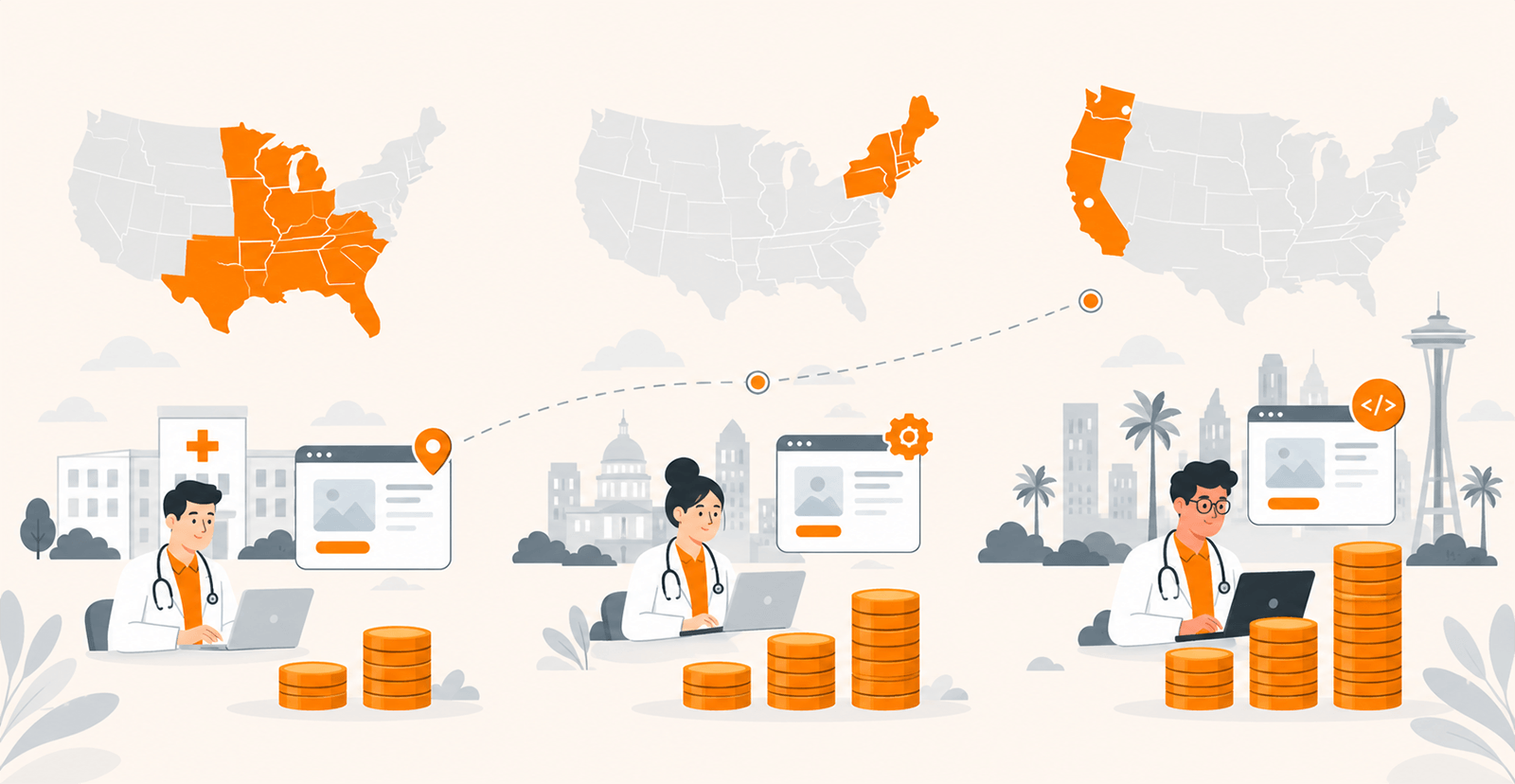
Geography also influences healthcare website pricing because agencies charge different rates across the US markets. Agency hourly rates vary across US markets, which directly influences total project cost. The table below shows typical ranges by region.
U.S. Region | Typical Agency Hourly Rate | What Influences the Range |
Midwest and South | $100–$175/hour | Competitive agency markets with moderate operating costs |
Northeast | $150–$250/hour | Higher professional service rates in metros like New York and Boston |
West Coast and Tech Hubs | $175–$300+/hour | Premium rates driven by proximity to technology markets |
Note: Total project cost depends on scope and hours, not geography alone. A 400-hour project at $150/hour costs the same whether the agency is in Chicago or Charlotte.
Healthcare Website Cost by Feature and Integration Complexity
The biggest pricing jump happens when the healthcare website needs to interact with other technology. Designing a basic website roughly takes $15K-$25K. Once sophisticated scheduling, patient portals, telehealth, EMR/EHR connectivity, CRM systems, AI capabilities, or advanced analytics are added, the numbers can quickly rise to the bracket of $40K-$100K+.
Complexity Level | Typical Capabilities | Estimated Cost | What Drives the Increase |
Essential | CMS, service pages, provider information, contact, and basic booking | $15K–$25K | Primarily informational website |
Interactive | Advanced scheduling, patient resources, multilingual support, and stronger search | $25K–$40K | More sophisticated patient journeys |
Integrated | EHR/EMR, patient portal, telehealth or CRM integration | $40K–$75K | APIs, data exchange and integration testing |
Advanced | AI chatbot, personalization, advanced analytics and sophisticated SEO | $75K–$100K+ | Custom development and greater technical complexity |
Enterprise | Multiple healthcare systems, complex APIs, large-scale data and digital services | $100K+ | Enterprise architecture and ongoing technical governance |
Healthcare Website Cost: One-Time vs. Recurring Expenses
The initial website design quote is only a part of what a healthcare organization has to spend. Once it's launched, you will have to invest continuously in hosting, security, software updates, content, SEO, backups, and technical support. A useful planning benchmark is 15-25% of the initial cost annually for maintenance.

Expense | Typical Initial Cost | Typical Recurring Cost | What the Organization Is Paying For |
Design & development | $15K–$100K+ | — | Strategy, UX/UI, CMS and website development |
Content & initial SEO | $2K–$20K+ | $1K–$5K+/month | Medical content, optimization, and ongoing publishing |
Hosting & infrastructure | $500–$5K+ | $500–$10K+/year | Hosting, SSL, backups, and infrastructure |
Maintenance & support | — | 15–25% of build cost/year | Updates, fixes, monitoring, and security |
Enterprise support | — | $25K–$100K+/year | Integrations, security, infrastructure, and continuous development |
Spend Smarter: How To Get More From Your Healthcare Website Design Budget
Define Your Website Requirements Before Requesting Quotes
Start by deciding what the website needs in real time to accomplish the goals before beginning with design. A small practice may only need appointment requests, provider information, service pages, and local SEO. Conversely, a large hospital would require EHR integration, a provider directory, patient portal access, and multiple location-specific pages. Writing these requirements down prevents you from paying for unnecessary functionalities that you will never use. It also makes comparing agency pricing easier, as vendor quotes will be for the same scope.
Choose a Healthcare-Experienced Design Partner
A healthcare-experienced website design agency will understand HIPAA considerations, WCAG accessibility, healthcare SEO, PHI handling, and patient-facing workflows. The experts won’t have to learn from scratch while working on your project. So, ask potential partners for examples of comparable healthcare websites and how they handled integrations, security, accessibility, and post-launch support. Paying $30K for an experienced team will generate better value in the future than paying $15K for a generalist team.
Open-Source vs. Proprietary CMS: Understanding the Trade-offs
Open-source platforms like WordPress and Drupal can reduce the initial costs because you won’t be building the entire CMS from scratch. These will also give your healthcare organization direct access to a large ecosystem of themes, plugins, developers, and integrations. Proprietary platforms, on the other hand, offer tighter control, specialized functionality, and enterprise-grade support. However, vendor dependency and licensing can increase long-term costs. So, the right choice depends on your organization type.
Conclusion
Healthcare website design costs in 2026 can range from $15K to $100K+, depending on the organization, website type, functionality, integrations, and compliance requirements. The smartest approach is not to choose the cheapest quote, but to invest where it directly improves patient experience, security, accessibility, and operational efficiency. Define your requirements early, select a healthcare-experienced design partner, choose the technology carefully, and treat HIPAA and security as essentials. A well-planned budget can deliver a stronger website without paying for unnecessary complexity.
Build a Smarter, Secure Healthcare Website With Quixta
Need help scoping and budgeting your healthcare website? Quixta designs and builds websites for practices, clinics, and hospitals with the right balance of patient experience, accessibility, security, and scalability. We'll help you define the scope, avoid unnecessary costs, and deliver a website that supports real patient acquisition.
FAQs
The healthcare website design cost for a template-based site runs $15K-$25K, while a fully custom website can range between $40K-$100K+. Templates reduce design and development time because the underlying structure already exists. Custom design, on the other hand, requires UX research, wireframes, unique interfaces, CMS architecture, and tailored functionality. For a small practice with straightforward needs, a customized template can provide better value. Larger clinics and hospitals can benefit from custom designs because their provider directories, patient journeys, integrations, and content structures require greater flexibility.
Two agencies can quote very differently because they may define the same website differently. One proposal may include strategy, custom UX, content migration, accessibility testing, SEO, security, and post-launch support. On the other hand, another may cover only design and development. The team structure and hourly rates will also matter. A healthcare specialist may charge more because its designers understand HIPAA considerations, EHR integrations, WCAG requirements, and healthcare-specific UX. So, you must always compare the scope, deliverables, integrations, revisions, and ongoing support behind each price rather than comparing the headline figure alone.
Healthcare website projects can be priced either as a fixed project fee or on an hourly basis, although larger projects combine both approaches. A fixed-price contract works well when the scope, functionality, integrations, and deliverables are clearly defined. Hourly billing provides more flexibility when requirements are likely to evolve. Some agencies use a fixed fee for discovery and design, and then move to hourly or milestone-based development. Before signing, clarify what happens when requirements change, how additional work is billed, and whether third-party costs are included in the quoted price.
Yes, phased design can make a large healthcare website more financially manageable. A practice may initially launch its core services, provider information, appointment functionality, mobile experience, and SEO foundation, then add a patient portal, telehealth, advanced search, or deeper integrations later. This approach can prevent an organization from spending $75K-$100K+ before it has validated what patients actually need. However, it’s best to invest in a scalable architecture from the beginning so that future expansion plans can be accommodated easily without needing a complete redesign.
You can reduce costs by limiting unnecessary customization and prioritizing functionality patients actually need. A small practice does not necessarily need a bespoke animation system, complex personalization, or dozens of custom page templates. Using a well-supported CMS and starting with fewer high-value pages can also control the initial investment. However, reducing costs on accessibility, security, mobile UX, content quality, or core patient workflows can create problems later.
Compare proposals by deliverables rather than by their total price. First, check whether both agencies have included the same number of templates, pages, design revisions, CMS functionality, integrations, content migration, SEO accessibility work, testing, and launch support. Then examine what happens after launch. One agency might quote $30K but exclude maintenance and integration work that another includes in a $40K proposal. Ask both agencies to price the same scope and clearly identify exclusions. A lower quote is not necessarily cheaper if important work appears later as change orders.
It can, particularly when the website involves HIPAA-sensitive workflows, patient portals, EMR/EHR integrations, accessibility requirements, or complex healthcare content. A specialist may charge more initially, but their experience can reduce costly misunderstandings and rework. Healthcare UX also has different priorities from conventional business websites, as patients need to find providers, services, insurance information, locations, and appointments quickly. For a simple informational practice website, paying a premium price for highly specialized expertise may not always be necessary.
There is no fixed percentage, because the impact depends on when the change occurs and what it affects. Adding a page late in the project may cost modestly. Changing navigation, CMS architecture, or an EHR integration after development has started can be substantially more expensive, as approved designs may need revision and testing restarted. The safest approach is to finalize requirements during discovery and maintain a documented change-control process so every addition has a clear cost and timeline impact.
Ask what the quoted price actually includes and what it excludes. Clarify who owns the website and design files, which CMS will be used, how many design revisions are included, and whether content migration, SEO, accessibility testing, security work, and launch support are covered. Ask specifically how the agency handles HIPAA-related requirements if PHI will be involved. You should also understand the post-launch arrangement, including maintenance rates, response times, third-party licensing, and the cost of additional design work.
Calculate the ROI by connecting the website to measurable patient and business outcomes, not simply traffic. Track appointment requests, completed bookings, calls, provider searches, contact submissions, and conversions from organic and paid campaigns. If a redesigned website costs $40K and generates an additional $100K in attributable revenue over its measurement period, the investment becomes easier to justify.
