
Quixta mark

4.5 Stars

Clutch-Hero-Section

4.5 Stars

DesignRush logo

Healthcare Software Development Services

Get custom healthcare software that helps hospitals, clinics, and health tech companies manage patient records, care coordination, and operations from a single system.

Our custom healthcare software development services can replace fragmented EHR data, manual scheduling, and compliance guesswork with secure, interoperable systems built around how clinicians and patients actually work.
Trusted by 200+ companies worldwide


  • UNICEF
  • ministry-of-education
  • igauge
  • Big Banyan
  • auto express
  • CDA golden star
  • helixr
  • profx
  • yoo architecture

We build secure, compliant healthcare software that connects patient data, providers, and workflows, helping your organization deliver better care without adding administrative overhead.

Our Numbers

480+Projects Delivered
23Countries Served
8+Years of Industry Experience
22+Tech Stack Mastered

What Are The Healthcare Challenges We Help You Solve

Patient records scattered across EHR systems, spreadsheets, and paper charts

Centralized patient data with structured, standards-based interoperability

Appointment scheduling and intake handled manually, leading to no-shows and bottlenecks

Automated scheduling, intake, and reminder workflows that reduce no-shows

Poor interoperability between EHR, billing, and lab systems, forcing staff to re-enter data

Direct integration with EHR, billing, and lab systems so data moves without manual re-entry

Compliance work treated as a checklist instead of something built into the system

Compliance and audit logging built into the architecture from day one

Limited visibility into claims status, patient outcomes, and operational performance

Real-time dashboards for claims, patient outcomes, and operational metrics

How Our Healthcare Software DevelopmentServices Work

We build tailored healthcare systems aligned with your workflow model, be it a hospital network, a specialty clinic, or a health tech startup. Here are our custom healthcare software services, designed to help your organization scale: 

Connect your platform to existing EHR systems through standards-based interfaces, or build custom EMR functionality for practices that need workflows a generic system doesn't support.

Build secure video consultation, scheduling, and virtual triage tools that let patients access care remotely without compromising clinical documentation or compliance.

Give patients self-service access to appointments, records, messaging, and billing, reducing front-desk workload while improving patient satisfaction.

Connect wearables and home monitoring devices to your platform so care teams can track patient vitals and intervene before a condition escalates.

Manage scheduling, staff workflows, bed and resource allocation, and administrative operations in one system built around how your facility actually runs.

Automate claims generation, eligibility verification, and denial management, reducing the manual work behind getting paid correctly and on time.

Give clinicians real-time, evidence-based guidance at the point of care, built around your specific clinical protocols and specialty workflows.

Track patient outreach, referrals, and follow-ups across care teams so no patient falls through the cracks between visits or providers.

Monitor patient outcomes, claims performance, and operational metrics through dashboards built for clinical, administrative, and executive teams.

Build the access controls, encryption, audit logging, and Business Associate Agreement-ready infrastructure your platform needs to handle protected health information correctly.

Give clinicians and patients dedicated mobile access to records, scheduling, and communication, built to the same security standard as your core platform.

Move aging hospital or clinic systems to secure, modern cloud infrastructure, improving reliability and integration speed without disrupting active patient care.

Hear What Our Clients Have To Say

clients
468+

clients

Global reach in 32+ countries

Different markets need different answers. Building across time zones and languages is just how we work now.

9 years and 11 months

since inception

since inception
who worked
8 out of 10 clients

who worked with us, go on to do multiple projects with us

00:00
The front end and the back end were both quite technical. They built the lot. We looked at a few different parties. Quixta was our preferred choice, and we're really happy.

Nathan Stapleton

Founder
Raffle Raise

Built For Hospitals, Clinics, And Healthcare Institutions

Our custom healthcare software is built for hospitals, specialty clinics, telehealth companies, and health tech startups wanting to move from manual, fragmented systems to connected digital infrastructure. 

01.

Hospitals & Health Systems 

Quixta's healthcare software help you modernize scheduling, records, and reporting across departments without disrupting active patient care.

02.

Private Practices & Specialty Clinics 

Our healthcare software development supports scheduling, patient intake, and billing systems sized for a single practice or a multi-location group, without the overhead of enterprise hospital software.

03.

Telehealth & Virtual Care Companies 

We build video, scheduling, and clinical documentation systems designed for platforms that deliver care primarily online, with the compliance work built in from the start.

04.

Diagnostic Labs & Imaging Centers 

Our systems are designed to manage test orders, results delivery, and referring-provider communication, reducing turnaround time and manual coordination.

05.

Remote Monitoring & Digital Health Startups 

Get a platform built to connect wearables and monitoring devices to clinical workflows, so care teams can act on patient data instead of just collecting it.

06.

Mental & Behavioral Health Providers

Access scheduling, secure messaging, and documentation tools built around the specific privacy and continuity-of-care needs of behavioral health practices.

Check Out Our Work On Healthcare Software Development

Aborwell project

Aborwell

HealthcareUnited States

A US healthcare provider running insurance verification and physical therapy assessments across a national therapist network.

Vitalflow project

Vitalflow

HealthcareUnited States

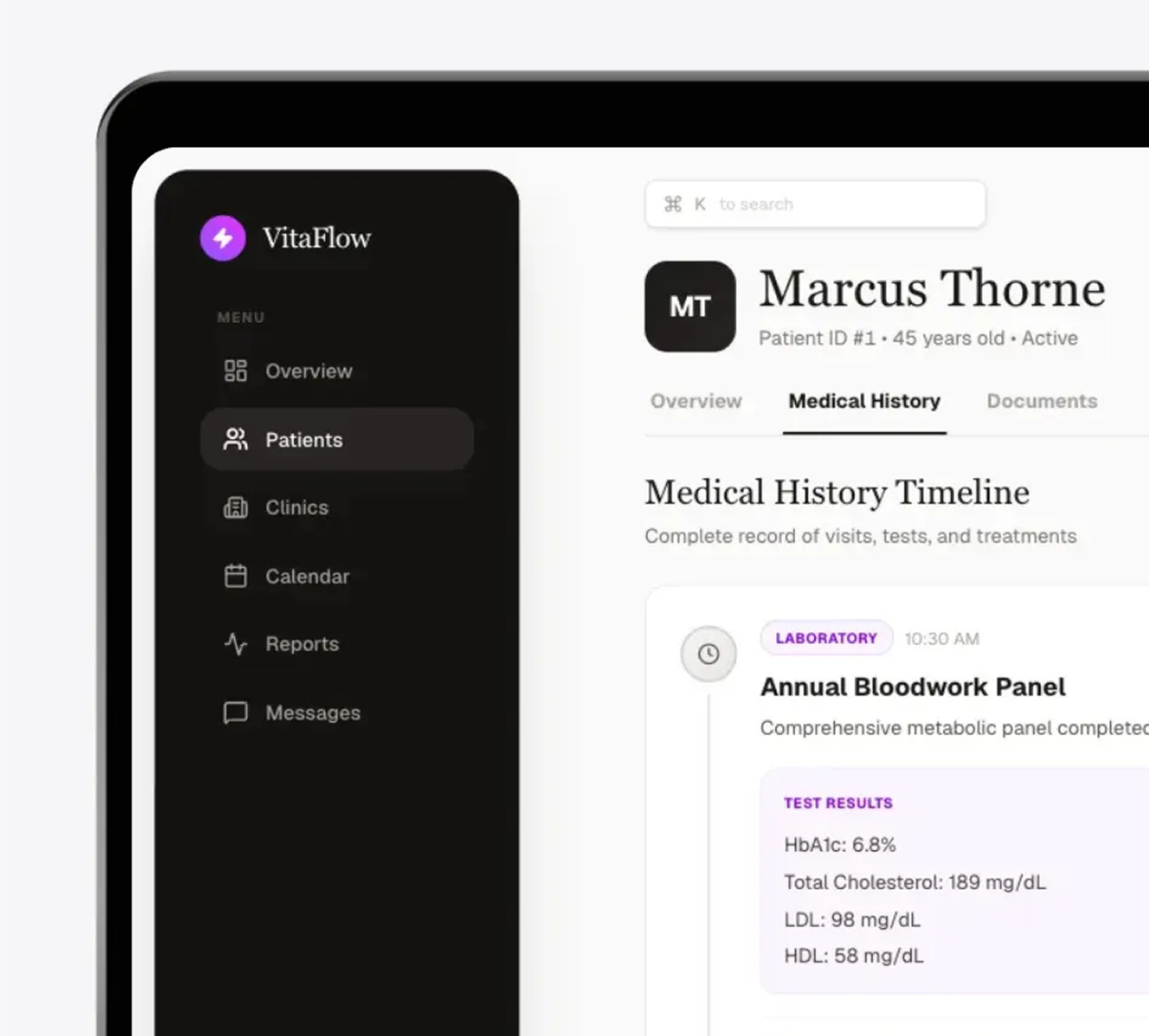
A multi-clinic healthcare network in the US handling patient records, scheduling and billing across every location.

Like What We Are Doing? Get Us To Work For You

Book our free consultation with our team of experienced software developers to modernize your healthcare operations and scale your platform with Quixta's custom healthcare software services

What Is The Cost Of Healthcare Software Development?

The cost of healthcare software ranges from $40,000 to $800,000+, depending on project complexity, compliance requirements, integrations (EHR systems, billing platforms, lab systems), and whether there's a need for web, mobile, or both applications.

Basic tools / MVPs

$40,000- $150,000

Suitable for a single-purpose MVP such as a patient intake tool, a basic scheduling app, or a telehealth product with limited integrations.

Mid-level platforms

$150,000–$350,000 

Covers multi-user systems such as patient portals, telehealth platforms with EHR read access, or practice management software with billing and scheduling built in. 

Enterprise systems

$350,000–$800,000+

Includes large-scale platforms such as hospital management systems, bidirectional EHR integrations, or clinical decision support tools that need to handle high patient volumes and multiple integrations.

These ranges reflect current US market rates for custom healthcare software development. HIPAA compliance work, including PHI safeguards, audit logging, access controls, and required risk assessments, typically adds a meaningful share to the base development cost, since this work is architectural and cannot be added after the fact without significant rework.

The full cost of your project depends on feature scope, integration count, and the compliance requirements of your specific healthcare setting.

Want to Know More About Healthcare Software Development Cost?

How Do We Approach Healthcare Software Development?

[01]

Clinical Workflow & Compliance Discovery 

Before any architecture discussion, we map out how the healthcare operations actually happens in your setting, like who touches patient data, at what point in the workflow, and which regulations govern that data (HIPAA, state telehealth rules, or others relevant to your specialty). This shapes every decision that follows.

[02]

Architecture & PHI Safeguards Design 

We design the system around how protected health information moves through it, deciding early where encryption applies, how PHI is isolated from other data, and how the system behaves when a downstream system, like an EHR or lab feed, is unavailable.

[03]

Building the Compliance Backbone First 

Audit logging, consent management, and access controls get built into the foundation before patient-facing features. We incorporate compliant systems during the development process, rather than putting it off for later.

[04]

Interface Design for Clinical Trust and Usability

A confusing screen in a clinical setting can mean a missed medication, a delayed referral, or a frustrated patient who never returns. We design every flow, from patient intake to a clinician's dashboard, to be clear, accessible, and fast to use under real clinical time pressure.

[05]

Development in Vertical Slices

We build in complete, testable slices, a full patient intake flow, a full scheduling flow, rather than horizontal layers that only come together at the end. This means your clinical and administrative teams can test real workflows early, instead of waiting for a big-bang integration.

[06]

Security Testing & Compliance Validation

Before launch, we test the scenarios that actually break healthcare products: interoperability failures between systems, access-control gaps, and edge cases in how PHI is displayed or logged. Where required, this includes coordinating third-party security testing and preparing documentation for a HIPAA risk assessment.

[07]

Phased Rollout & Post-Launch Monitoring

We do phased rolllouts so issues surface before they affect broader patient care. After launch, we monitor system performance and continue to support the platform as regulations and your clinical needs evolve.

Tech Stack we use

HTML5HTML
CSSCSS
JavascriptJavaScript
TypeScript 2ndTypeScript
PythonPython
ReactjsReact.js
NextjsNext.js
VueJSVue.js
Tailwind CSSTailwind CSS
BootstrapBootstrap

Modern Technologies We Use For Our Healthcare Software Development

1.

Interoperability Through FHIR & HL7 Standards 

We build platforms around standards-based interoperability from the start, so your system can exchange data with EHRs, labs, and other providers without custom point-to-point integration work every time you add a connection.

2.

AI-Assisted Clinical Decision Support 

We use machine learning models to support, not replace, clinical judgment, surfacing relevant patient history, flagging potential drug interactions, or highlighting risk patterns at the point of care, with clinicians always making the final call.

3.

Remote Patient Monitoring & Wearable Integration 

We connect consumer and clinical-grade wearables and home devices to care platforms, turning continuous patient data into alerts and trends that care teams can act on instead of raw numbers nobody reviews.

4.

Telehealth & Real-Time Clinical Communication 

We build virtual care infrastructure around secure, low-latency video and messaging designed for clinical use, including the documentation and consent workflows that general-purpose video tools don't handle.

5.

HIPAA-Compliant Cloud Infrastructure 

We architect cloud environments with the encryption, access logging, and Business Associate Agreement-ready configuration that protected health information requires, since major cloud providers support compliance but don't guarantee it out of the box.

Why Choose Quixta For Your Healthcare Software Development Needs?

Team member in thoughtful pose

Clinical Workflow Fluency 

Our team understands how intake, scheduling, and care coordination actually work in a clinical setting, so we build systems around your real workflows instead of a generic template.

Built-In Compliance Systems 

We build the evidence trail in from the start, including access logs, consent records, and audit documentation that hold up under a HIPAA risk assessment.

Robust Engineering Discipline 

We write for edge cases, failure states, and data accuracy, not just the happy path, because a bug in a healthcare product can affect patient safety.

Complete Transparency Through Every Sprint 

Throughout the development process, we keep your clinical and administrative stakeholders close to the build so there are no surprises about scope, timeline, or what's actually shipping.

Post-Launch Support

Our team stay engaged post-launch to adapt your platform as requirements evolve, rather than handing off a finished product and disappearing.

Before & After: Real Impact Of Our Healthcare Software Development

Patient Records

Before Custom Software

Scattered across systems and paper charts

After Quixta's Solution

Centralized, interoperable data accessible at the point of care

Scheduling

Before Custom Software

Manual, prone to no-shows

After Quixta's Solution

Automated scheduling and reminders that reduce missed visits

Billing & Claims

Before Custom Software

Manual processes, delayed reimbursement

After Quixta's Solution

Automated claims and eligibility checks that speed up payments

Compliance Reporting

Before Custom Software

Manual, reactive to audits

After Quixta's Solution

Built-in audit trails and documentation ready for review

Care Coordination

Before Custom Software

Fragmented across providers

After Quixta's Solution

Unified care team visibility across visits and referrals

Build A Healthcare Software For Your Modern Care Operations

Quixta helps develop robust, reliable, and compliant healthcare software that fits your existing care operations and integrated with modern capabilities. 

A few things people usually ask before reaching out.

Healthcare software development typically costs between $40,000 for a focused MVP and $800,000 or more for an enterprise-grade platform. Cost depends mainly on how many features and integrations the platform needs and how much compliance work is required, since HIPAA safeguards and EHR integrations add significant engineering effort.

Yes, this is typically done through a phased migration rather than a single cutover, running the new system alongside the old one until it's validated, then shifting departments or workflows over one at a time. This is usually a faster and lower-risk path than a full rebuild if the existing system still functions but is difficult to maintain, scale, or integrate with newer tools.

Building healthcare software typically takes three to six months for an MVP and up to twelve months or more for a full-featured platform. Timelines stretch out when a project involves EHR integration, multiple user roles, or extensive compliance testing before launch.

Off-the-shelf healthcare tools get you running faster but limit how much you can adapt the product to your specific clinical workflows and patient population. Custom healthcare software takes longer to build but gives you full control over features, integrations, and data, which usually matters once a practice or platform needs the software to fit how care actually happens rather than a generic template.

Look for a development partner with a track record in regulated healthcare products, not just general software experience, since healthcare projects carry compliance and interoperability requirements that generic development teams often underestimate. It also helps to ask about their EHR integration experience, how they handle HIPAA compliance and security testing, and whether they offer support after launch.

Healthcare software carries a higher bar for privacy, security, and regulatory compliance than most other software, because it handles protected health information and can directly affect patient safety. This means access controls, audit logging, and interoperability standards are built into the product from the start, rather than added on as extra features later.

Telemedicine software development for a healthcare startup typically costs between $30,000 and $80,000 for a focused MVP covering video consultations, scheduling, and basic patient records, and between $80,000 and $150,000 for a mid-range platform with prescription management, secure payments, and richer provider workflows. A full-scale platform with EHR integration, AI-assisted triage, and remote patient monitoring can run from $150,000 to $400,000 or more.

Patient consent is typically captured, timestamped, and stored as part of the patient record, with the system tracking what the patient agreed to and when, especially for telehealth visits, data sharing, and research participation. This needs to be built into the platform's data model from the start so consent records hold up if they're ever reviewed.

Healthcare software stays secure and compliant through a combination of encryption, role-based access controls, audit logging, and regular security testing, built around HIPAA requirements and any state-specific regulations relevant to your practice. Compliance requirements also change over time, so the platform needs to be built in a way that allows rules to be updated without a full rebuild.

Yes. Most consumer and clinical-grade wearables and home monitoring devices can feed data into a healthcare platform through device manufacturer APIs or standard health data protocols. The harder part is usually not the data connection itself, but building the alerting and workflow logic so care teams act on meaningful changes instead of being flooded with raw readings.

Ready to Grow Your Business?

Schedule a Call to Discuss