Real-Time Warehouse Management System Development for a Multi-Site Logistics Company | Case Study
Industry
Logistics & Supply Chain
Target Market
United States
Project
Warehouse Management Platform
Key Outcomes
87% reduction in appointment scheduling conflicts | Achieved 60% decrease in administrative overheads | 42% improvement in revenue cycle efficiency
Services
Ideation, Design, Development, and Deployment
About Our Client
Our client is a rapidly expanding logistics and fulfillment provider with multiple warehouses across the United States. They process thousands of SKUs daily, manage a fleet of automated guided vehicles (AGVs), and serve e-commerce clients who demand real-time visibility into their inventory and orders.
As their operations scaled from a single facility to multiple specialized warehouses, their legacy systems couldn’t keep pace with the complexity of multi-site operations, real-time data needs, and automated workflows, impacting performance and operational efficiency across the board.
What Were The Business Challenges
As operations scaled, our client faced growing business and data challenges.
Key problems include:
- No unified visibility across multiple warehouse sites
- Manual tracking of AGV fleet, leading to under-utilization and frequent downtime
- Inventory discrepancies due to a lack of real-time zone synchronization
- Inefficient picking and packing workflows, delaying order fulfillment
- Limited visibility into the shipment status once orders leave the warehouse
- Reactive inventory replenishment resulting in frequent stockouts
- No predictive analytics for fleet maintenance or capacity planning
- Manual alert management, delaying critical issue responses
- Inability to track cross-warehouse logistics chains and item relationships
- Poor coordination between receiving, sorting, and outbound operations
How We Solved The Problems
Quixta delivered a real-time warehouse management system designed to provide visibility, automation, and predictive insights across all operations.
We did this by:
- Developed a comprehensive multi-warehouse dashboard showing key performance metrics and live zone visualization
- Built an autonomous AGV fleet management system with automatic task assignment and battery optimization
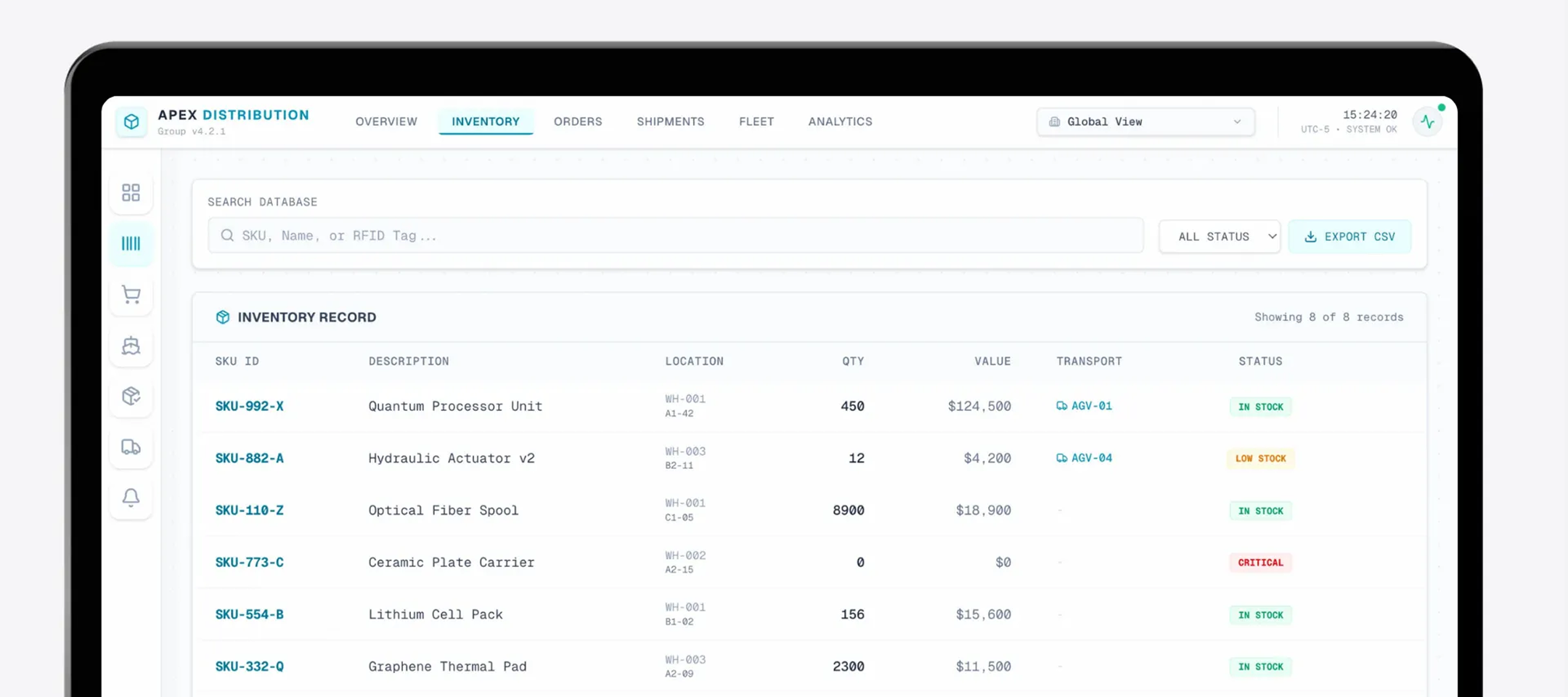
- Implemented real-time inventory tracking with RFID integration and automated status updates
- Created an end-to-end order management system with picking progress visualization and AGV coordination
- Integrated shipment tracking through carrier API connections and delivery ETA predictions
- Established intelligent receiving workflows with dock assignment and priority scheduling
- Deployed an advanced analytics dashboard with customizable time ranges and KPI tracking
- Built an automated alert system with categorization and acknowledgment workflows
- Created cross-module data relationships enabling seamless navigation between inventory, orders, and fleet
- Designed a real-time telemetry system with auto-scrolling logs and system health monitoring
- Ensured a responsive interface optimized for mobile and desktop devices
- Added CSV export capabilities with full audit trail logging for compliance
What Was Our Process
Step 01
Discovery & Alignment
Step 02
Architecture & Planning
Step 03
UX & Workflow Design
Step 04
Platform Development
Step 05
Testing & Compliance Validation
Step 06
Deployment & Optimization
What Was The Result of Our Warehouse Management System Development
The new platform delivered measurable operational improvements, such as:
- 78% improvement in fleet utilization through automated AGV task assignment and battery management
- 92% reduction in inventory discrepancies with real-time RFID tracking and zone monitoring
- 65% faster order fulfillment through optimized picking workflows
- 40% reduction in stockouts with predictive analytics and automated replenishment alerts
- 85% faster response to critical alerts due to automated categorization and notification
- Real-time visibility across all warehouse locations, eliminating information silos
- 50% improvement in dock turnaround time with intelligent scheduling and capacity monitoring
- Enhanced decision-making capabilities through visualized analytics and trends
- Scalable architecture supporting unlimited warehouses, SKUs, and fleet expansion
- Operational cost savings through preventive fleet maintenance and optimized resource allocation
Tech Stack Used
Frontend
React.js
Backend
Node.js
Database
PostgreSQL
Backend
MQTT
Database
Redis
Communication Protocol
WebSocket
API
TensorFlow
Database
Redis
Communication Protocol
WebSocket
API
TensorFlow
Why Choose Quixta for your Warehouse Management System
Proven experience with real-time, high-complexity systems
Ability to translate operational chaos into structured workflows
Strong focus on measurable business outcomes
Scalable system architecture built for growth
Balanced engineering and usability
Step Into The Future of Logistics & Supply Chain Innovation
If your logistics workflows span multiple facilities, fleets, and SKU volumes, Quixta provides logistics software development services with real-time systems that unify operations, automate workflows, and surface insights where teams need them most.
Frequently Asked Questions
How long does a real-time warehouse management system take to build?
- A full custom real-time system typically takes 4–8 months, depending on integrations (AGVs, RFID, carriers) and analytics complexity.
How much does a real-time warehouse management system cost to build?
It costs around $180,000 - $350,000 for a custom warehouse management system. However, costs vary with integration complexity, telemetry depth, analytics, and scalability requirements.
Can this platform integrate with existing ERPs, carriers, or automation systems?
Yes. It is built to support API integrations with ERPs, carriers, automated fleet systems, and fulfillment technologies.
How does real-time inventory tracking work?
Inventory is synchronized via RFID and zone monitoring, ensuring up-to-the-moment accuracy across picking, staging, and storage areas.
Is the platform scalable for future expansion?
Yes. The foundational architecture supports unlimited SKUs, warehouse sites, fleet units, and deeper analytics modules.
Related Blogs
- Healthcare Software
- HR Software
- HR Software
Connect with us today
Schedule Your Discovery Call
Request A Quote
Complete the form below, and we’ll get back within one business day.