TLDR
- White label web design gives agencies access to external design and development teams. Best for custom projects, complex functionality, and ongoing support.
- AI website builders generate initial website structures from prompts and descriptions. Best for simple sites, landing pages, prototypes, and speed-critical projects.
- Neither guarantees quality on its own. White label outcomes depend on the partner's skills; AI outcomes depend on the platform's capabilities and the agency's review process.
- Most agencies benefit from using both: AI for initial concepts and repeatable work, a white label partner for custom development and projects that exceed the platform's capabilities.
- Compare total delivery costs, not just the partner's quote or the platform's subscription. Staff time, revisions, testing, and maintenance all factor into the actual project cost.
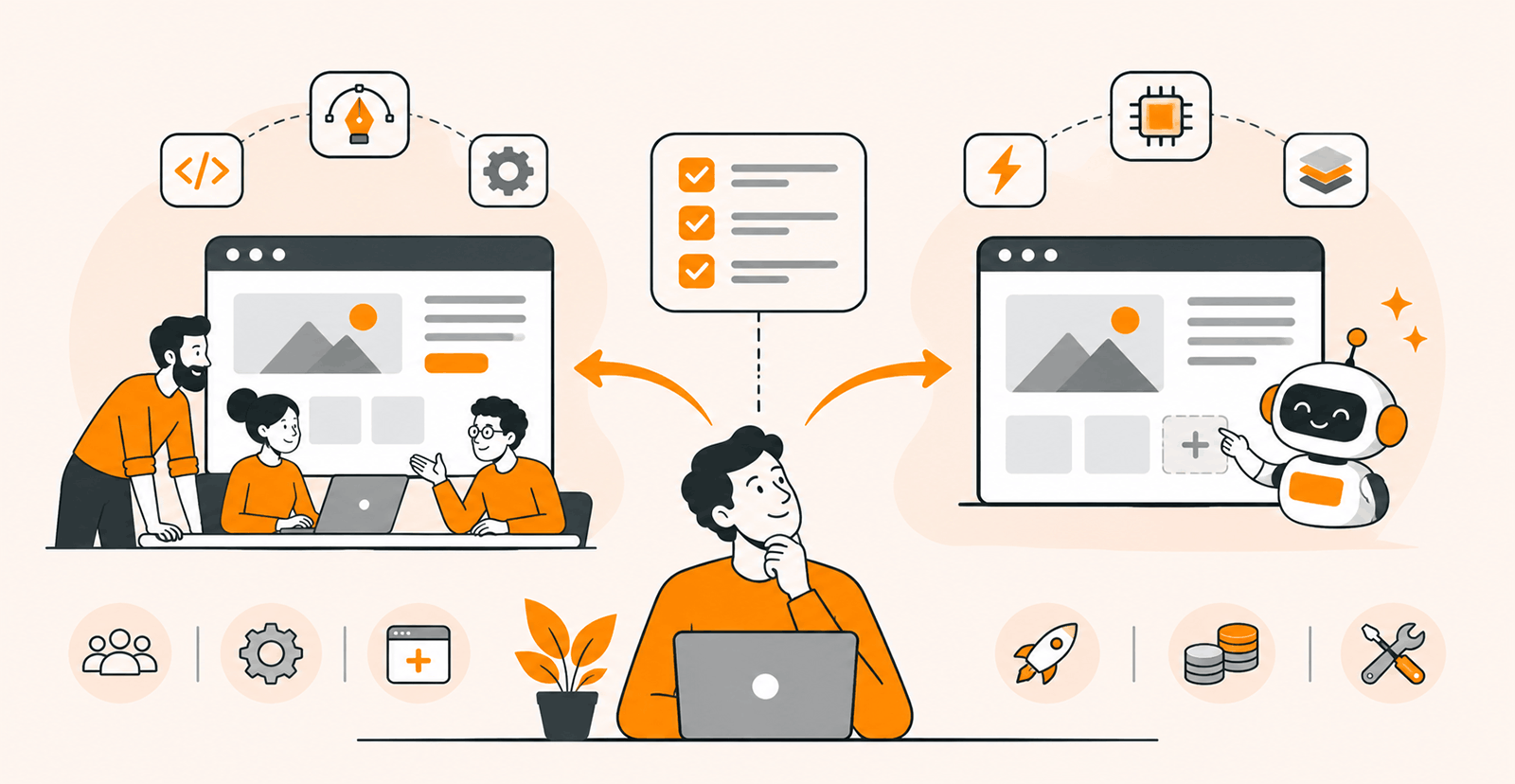
Agencies should use white label web design when they need specialist skills, extra delivery capacity, or custom functionality, and AI website builders when they need to produce simple websites, landing pages, or prototypes quickly. For most projects, a combination of both approaches gives the best balance of speed and quality.
White label web design is a service model where an external team designs and develops websites under the agency's brand. AI website builders are software platforms that generate website layouts, content, and page structures from prompts and descriptions. Both reduce the need for a large in-house production team, but they solve different problems.
White Label Web Design vs AI Website Builders: A Quick Comparison
White label web design is a service model, while an AI website builder is a software tool. The right choice depends on whether an agency needs an external team to deliver a project or a tool to help its existing team build websites faster.
Comparison factor | White label web design | AI website builders |
What it provides | Website design and development through an external partner | Software that generates and assists with website creation |
Initial setup | Partner selection, project brief, and scope agreement | Business description, prompts, and platform configuration |
Design flexibility | Depends on the partner's design and development capabilities | Depends on the builder's editing and customization options |
Delivery speed | Depends on project complexity and partner availability | Can generate an initial website quickly |
Technical expertise | Supplied by the partner within the agreed scope | Basic projects may need little technical expertise; complex work may require developers |
Custom functionality | Possible when the partner has the required skills | Depends on supported features, integrations, and customization options |
Cost structure | Project fees, retainers, or agreed service rates | Subscriptions, add-ons, and internal labor |
Quality assurance | Depends on partner standards and agency review | Requires agency review and testing |
Scalability | Can expand through additional partner resources | Depends on platform capabilities and the agency's workflow |
Best suited for | Agencies outsourcing website delivery or expanding services | Agencies producing simple sites, prototypes, and repeatable layouts |
What is white label web design, and how does it work?
White label web design is a service arrangement in which one company designs and develops websites on behalf of another company, which then delivers the finished work to its own clients under its own brand. The agency manages the client relationship, and the external partner handles production as agreed.
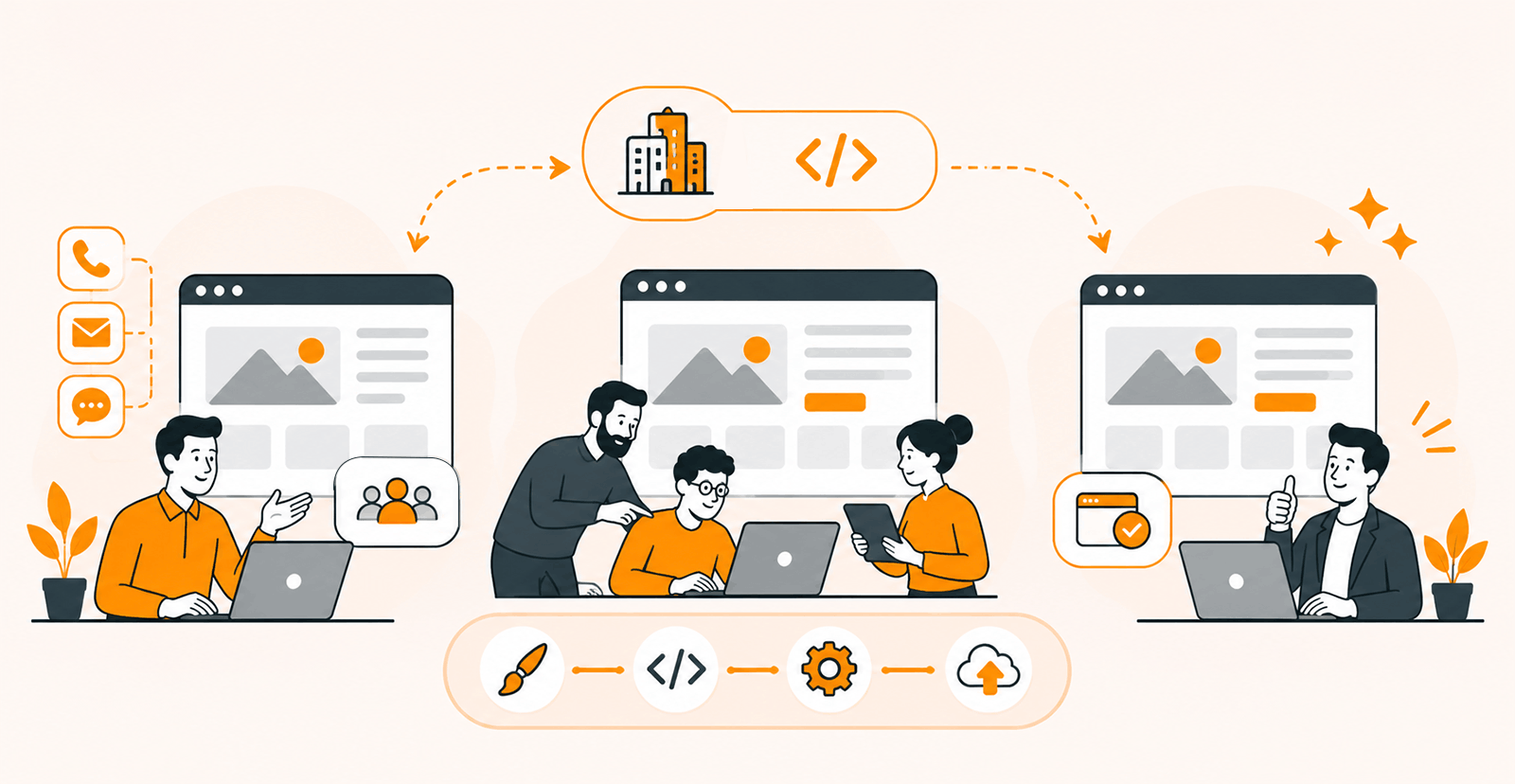
For example, a digital marketing agency may handle SEO, paid media, and social campaigns but lack in-house web developers. When a client requests a website redesign, the agency hires a white label web design partner to build it, without hiring permanent developers. The agency remains the client's primary point of contact throughout the project.
What services can a white label web design partner provide?
A white label partner's services depend on its team and technical capabilities. Common services include:
- Website design: Page layouts, visual styles, and user experiences aligned with the client's brand.
- Website development: Building approved designs on platforms such as WordPress, Webflow, or React-based frameworks.
- Content management setup: Configuring a CMS so the client can update content without rebuilding pages.
- Technical SEO: Implementing site structures and settings that support search engine crawling and indexing.
- Pre-launch testing: Verifying navigation, forms, mobile layout, and core functionality before handover.
- Ongoing maintenance: Updates, bug fixes, and technical support under a separate maintenance agreement.
Not every white label provider offers all these services. Agencies should verify the scope before starting a project.
Why do agencies use white label web design?
White label web design enables agencies to expand their service offering without building an entire in-house design and development team. This is useful when an agency regularly receives website projects but does not have enough designers or developers to complete every project internally.
An SEO agency, for instance, can maintain its search marketing campaigns and client relationships while a specialist partner handles site redesigns. The agency can offer a wider range of services without dedicating a full team to a single project. For agencies exploring this model, Quixta's guide on how to resell web design services without a design team covers the operational setup.
Outsourcing the production does not remove the agency's responsibility for managing expectations, reviewing deliverables, and verifying that the finished website meets the client's requirements.
What are AI website builders, and how do they work?
AI website builders are software platforms that generate website designs, layouts, and draft content based on user prompts and descriptions. They can reduce the initial time needed to start a new website, but the final result typically still requires editing, testing, and human review before it is ready for a client.
Several platforms now offer AI-assisted website creation features. Webflow's AI Site Builder generates website themes and initial structures from project descriptions. Wix Harmony uses natural language prompts to create and edit websites. Squarespace, Framer, and Durable also offer AI-driven site generation, each with different strengths in design flexibility, speed, and content management.
What can AI website builders do?
Depending on the platform, agencies can use AI website builders to:
- Generate initial page layouts from a written brief
- Create draft website copy and headings
- Suggest color schemes, typography, and design elements
- Produce standard pages for service businesses and portfolios
- Create starting points for landing pages and campaign websites
- Assist with routine content changes and design revisions
These features can reduce the time required to prepare an initial version of a website. They do not guarantee that the generated output will meet the client's brand, functionality, accessibility, or business requirements.
What do AI website builders still require from agencies?
AI-generated websites require human oversight before they are delivered as client work. An agency may need to replace inaccurate content, adjust the layout, validate the mobile experience, configure forms, and test integrations. Projects that require specialized functionality will also need a developer.
For example, an AI builder can generate the structure of a consultancy website. But if the client needs a custom appointment booking workflow integrated with their CRM, that functionality requires additional development. Creating a website is not the same as delivering a fully tested, client-ready website project.
Why are agencies comparing white label web design and AI website builders in 2026?
Agencies are evaluating both options because clients expect faster delivery, competitive pricing, and websites that support measurable business goals. AI tools can accelerate repetitive production tasks, while white label partners can add delivery capacity and specialized expertise.
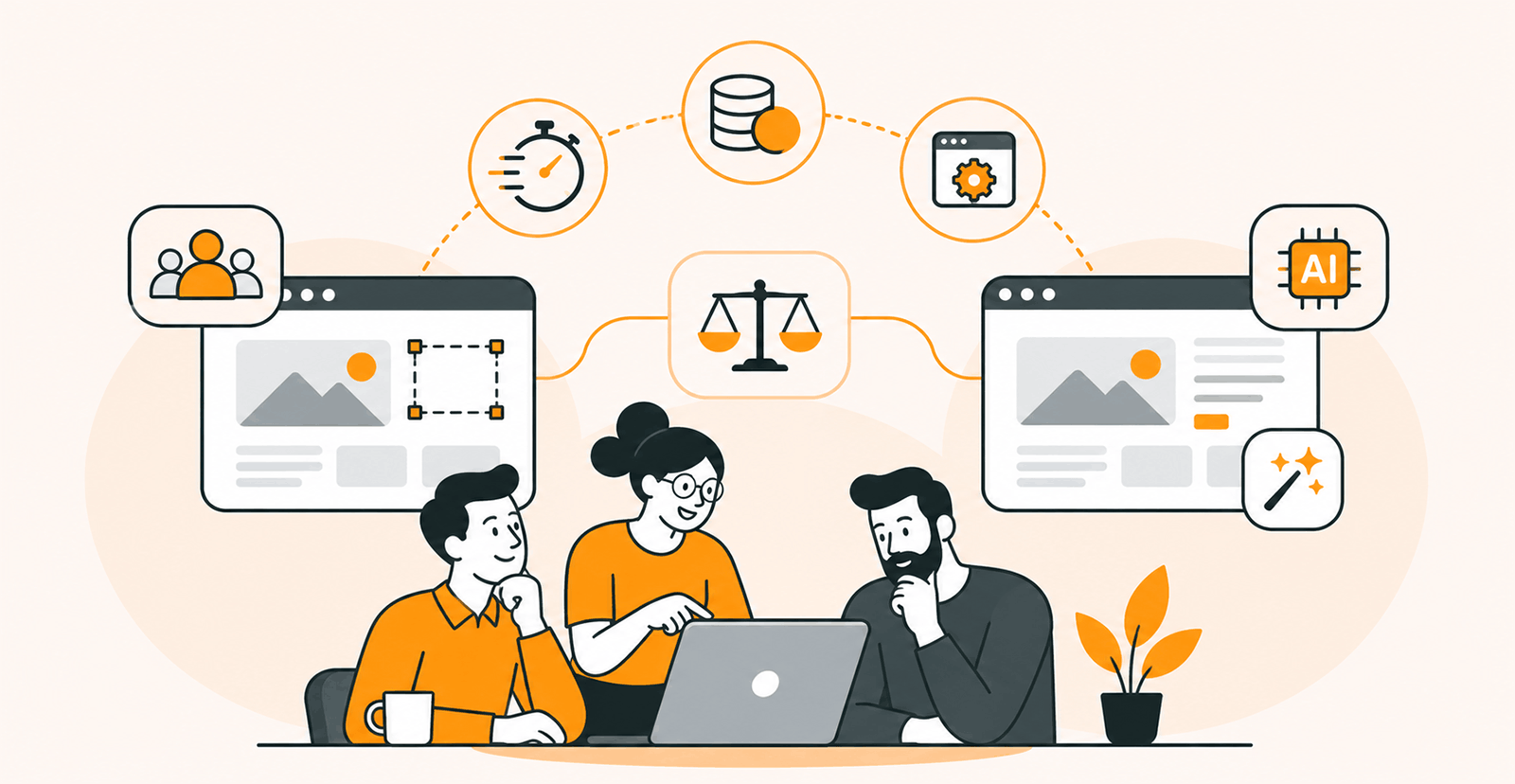
The comparison is not just about speed. It is also about total cost. Agencies need to consider the full project lifecycle, from briefing through launch and ongoing maintenance, to understand what each approach actually costs.
AI has changed the initial website-building process
AI-assisted website creation makes it easier to turn a business description into an initial website structure. This is particularly useful for creating concepts and exploring design directions without building every page from scratch.
However, the time required to generate a first draft is not the same as the time required to deliver a tested, client-ready website. Agencies should measure the full delivery process, including revisions, technical setup, testing, and client approval.
Agencies need to manage costs without reducing quality
An agency's project margin is the difference between the revenue earned from a project and the cost of delivering it. AI tools may reduce the time spent on routine tasks. White label partners can reduce the need for a large permanent production team. Neither guarantees higher margins on its own.
A cheaper initial build can cost more overall if it requires extensive corrections. An agency can also lose margin if it underestimates coordination time or agrees to ambiguous revision terms with an external partner. For a detailed breakdown of what white label arrangements actually cost, see white label web design pricing: what agencies actually pay in 2026.
What are the advantages and limitations of white label web design?
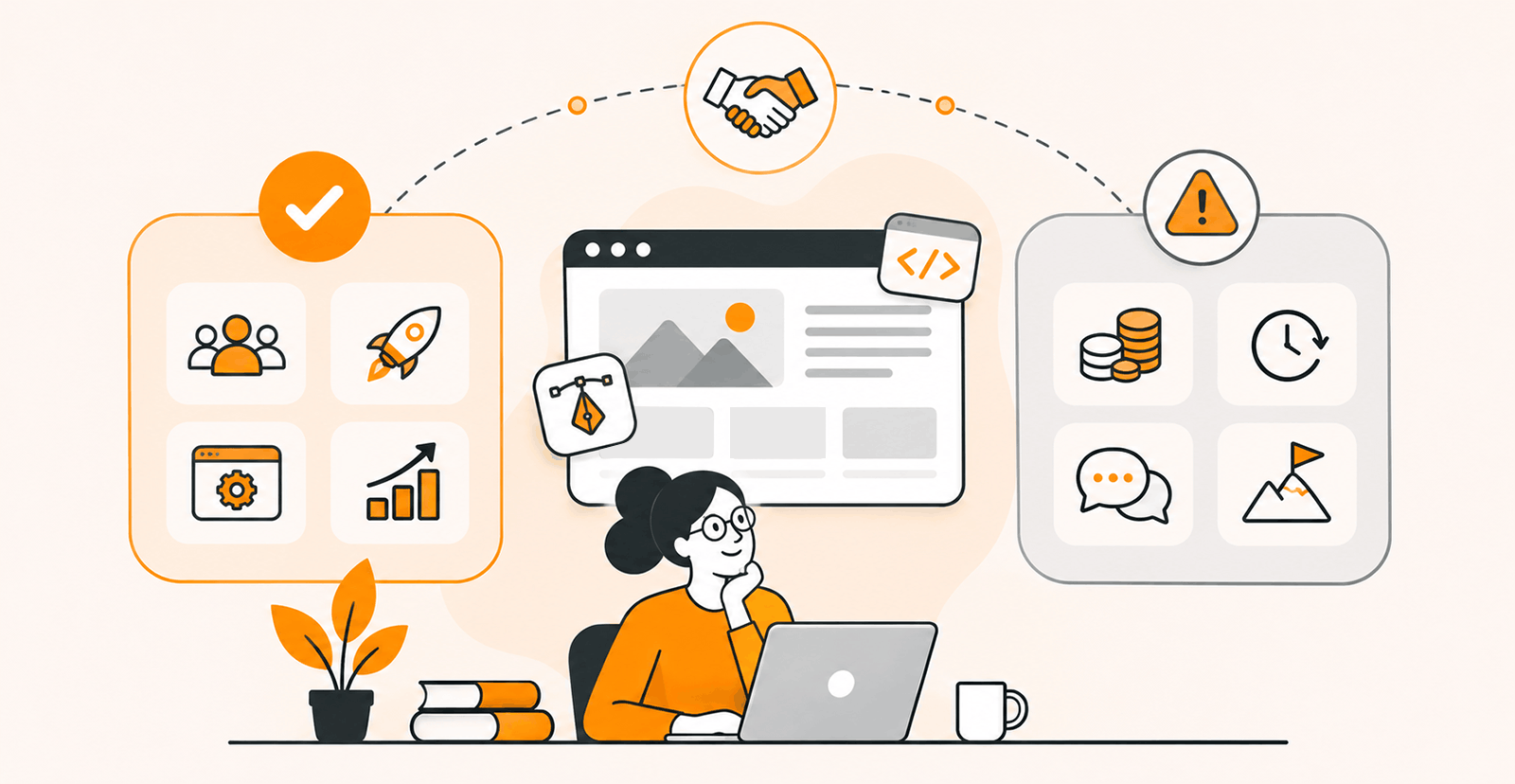
White label web design gives agencies access to external design and development resources without hiring all the specialists internally. The value depends on the partner's experience, rates, communication, and delivery consistency.
Advantages of white label web design
1. Access to specialist expertise
A white label partner can provide experienced designers, developers, testers, and project managers. Agencies can use those skills when a project requires capabilities their internal team does not have. A branding agency, for instance, may not need to hire developers permanently but can outsource a complex website build to a partner with WordPress or Webflow experience.
2. Greater delivery capacity
White label partnerships help during busy periods. If an agency receives multiple website requests at once, it can assign a project to an external partner rather than delaying work or hiring a full-time employee for a short-term need. This benefit depends on the partner's availability and the agency's project coordination.
3. Support for more complex projects
Custom page layouts, content management systems, third-party integrations, and specialized functionality can be handled by a partner with the right technical background. Agencies should evaluate the partner's practical experience with the technology in question before committing to specific functionality in a client proposal.
4. More time for client management and business development
Outsourcing production frees the agency to focus on strategy, sales, account management, and marketing. This benefit is strongest when the partner operates through a proven process and requires minimal correction.
Limitations of white label web design
White label web design also involves costs and coordination requirements:
- Partner fees: Project margins must account for external production costs, not just internal expenses.
- Coordination time: The agency must prepare briefs, communicate feedback, review deliverables, and manage approvals.
- External capacity dependency: If the partner's availability is limited or delayed, delivery timelines are affected.
- Quality variation: The agency must verify that the partner's work meets the agreed design, technical, and business requirements.
- Ownership and confidentiality: Contracts should address access to client data, ownership of deliverables, and confidentiality terms.
The strongest white label partnerships involve clear roles, realistic timelines, and a documented revision process. For agencies comparing this model against hiring in-house, white label web design vs hiring in-house breaks down the real cost difference.
Which approach is better for website quality, customization, and scalability?
White label web design is generally more suitable when an agency needs specialist production capabilities, while AI website builders are more practical for standard website requirements. Neither approach automatically guarantees better quality or scalability. The outcome depends on the partner's expertise, the platform's capabilities, the project scope, and the agency's quality checks.
Evaluation factor | White label web design | AI website builders |
Design quality | Depends on the partner's design expertise and review process | Depends on the generated output, editing options, and human review |
Customization | Can support custom requirements when the partner has the necessary skills | Limited or supported according to the platform's capabilities |
Complex functionality | Depends on the partner's technical expertise | Depends on available features, integrations, and extensions |
Initial production speed | Depends on the brief, scope, and partner availability | Can generate an initial website quickly |
Quality assurance | Requires partner checks and agency approval | Requires agency checks and testing |
Scalability | Can expand through additional partner resources and technical capabilities | Depends on platform limits and the agency's ability to manage more projects |
Maintenance | May be included through an ongoing support agreement | Depends on the platform and the agency's maintenance arrangement |
Long-term flexibility | Depends on the technology, contract, and ownership terms | Depends on platform features and migration options |
Agencies should assess the finished result rather than assume that a particular delivery method is inherently superior.
When should agencies use AI website builders?
Choose AI website builders when:
- The project is a simple business website. A homepage, service pages, an about page, and a contact form may not need custom development. An AI builder can generate the initial structure, and the agency refines it before delivery.
- You need to prototype or pitch concepts quickly. AI builders can generate visual concepts and site structures that help agencies present ideas to clients during pitch and discovery phases.
- You need landing pages for campaigns. Paid media and marketing campaigns often require landing pages built fast. AI builders can generate these from a brief so the agency can focus on conversion optimization.
- You serve a specific vertical with repeatable projects. Agencies building websites for dental practices, real estate agents, or fitness studios can use AI builders to produce consistent, template-driven sites at higher volume.
- You need internal or test websites. Staging environments, internal tools, and test sites do not need the same customization as client deliverables.
How to combine both approaches
Agencies can use AI for early planning and production, then bring in a white label partner for custom development and quality assurance. A practical workflow:
- Define requirements. Determine purpose, audience, page count, features, integrations, budget, and maintenance expectations. This decides whether an AI builder can handle the project or if a partner is needed.
- Use AI for initial concepts. Generate sitemap ideas, page outlines, draft copy, and design directions. Review and correct inaccuracies before presenting to the client.
- Bring in a partner if needed. Custom functionality, significant design work, or additional production capacity calls for a white label partner. Standard projects can stay within the AI builder.
- Build and refine. AI tools handle repeatable tasks; developers and designers focus on custom work.
- Test before launch. Check mobile responsiveness, navigation, forms, content accuracy, accessibility, performance, and search settings against the same project requirements for both AI-generated and partner-delivered work. Confirm website ownership, account access, and maintenance responsibilities before handover.
How to compare costs and choose the right approach
Comparing the actual cost
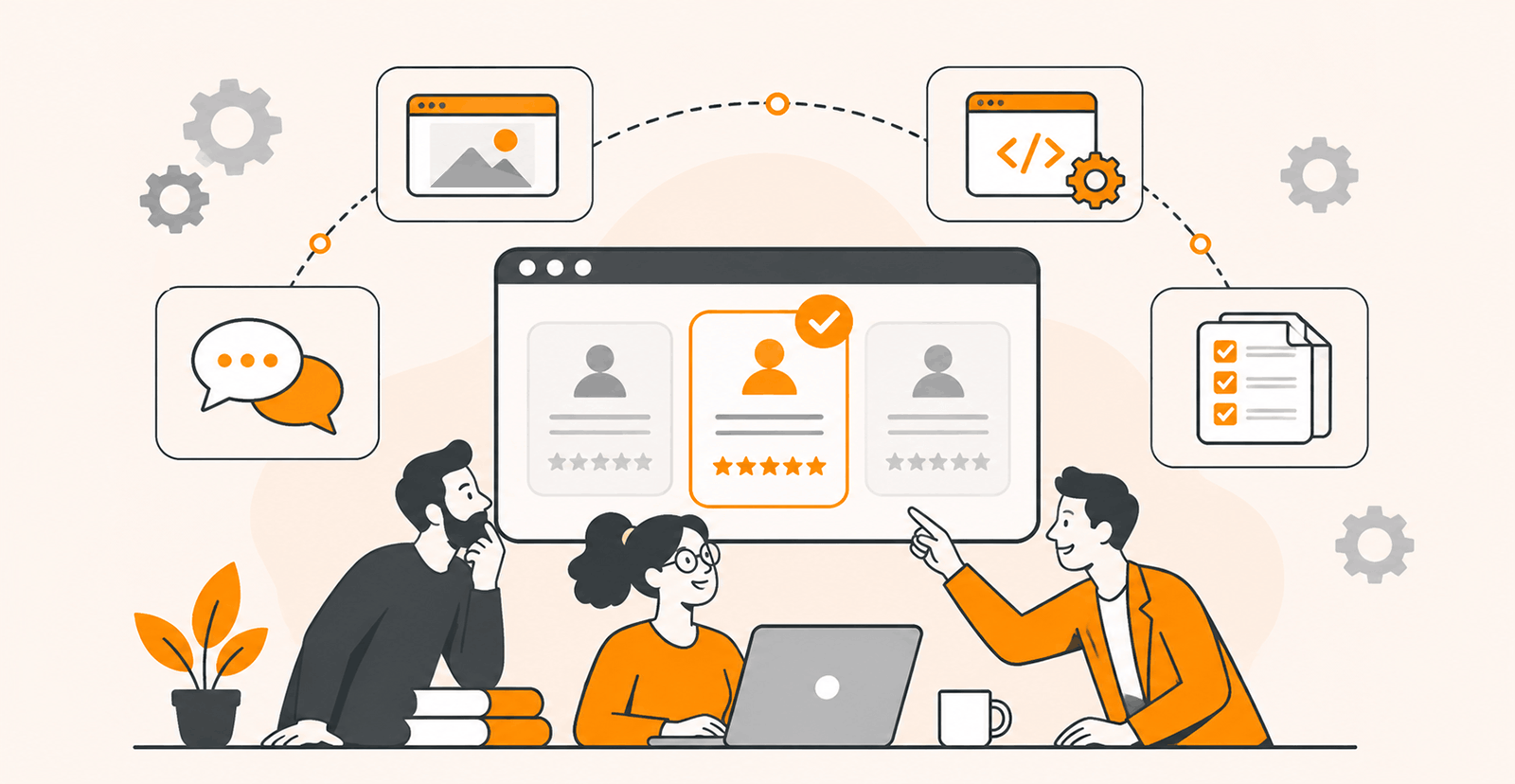
Agencies should compare total delivery cost, not just an AI subscription or a partner's quote. The full cost includes direct expenses and staff time for planning, building, reviewing, revising, testing, and maintaining the website.
Cost factor | White label web design | AI website builders |
Direct expense | Partner fees based on agreed scope | Platform subscriptions and optional paid features |
Internal labor | Briefing, coordination, reviews, and client communication | Prompt preparation, editing, troubleshooting, testing, and client communication |
Revision costs | Depend on the contract and change requests | Depend on staff time, platform limitations, and additional development |
Additional development | May be included or quoted separately | May require a developer or external partner |
Ongoing costs | Maintenance agreements and support fees, where applicable | Subscription fees, add-ons, and maintenance labor |
Main financial risk | Unclear scope, delays, and additional revisions | Underestimating the work required after initial generation |
For a detailed pricing breakdown, see white label web design pricing: what agencies actually pay in 2026.
Choosing the right white label partner
Evaluate partners on relevant experience, technical capability, communication, pricing clarity, and post-launch support. For a full evaluation framework, see how to choose a white label web design partner: 10 questions before you sign.
- Review relevant projects. Look at live websites the partner has delivered for similar projects. Evaluate design, mobile experience, functionality, and loading performance.
- Assess technical capabilities. Verify experience with the platforms you need (WordPress, Webflow, React, etc.). For WordPress-specific work, see the best white label WordPress development services for agencies.
- Check communication and project management. Confirm clear timelines, milestones, regular updates, and a defined process for scope changes and missed deadlines.
- Confirm pricing and ownership terms. Get a breakdown of deliverables, included revisions, exclusions, and ongoing costs. The contract should clarify ownership of all website files, design assets, code, and accounts.
Choosing the right AI website builder
Evaluate AI builders based on the project's design, functionality, ownership, and integration requirements. A platform that works for a simple business site may not suit a project with complex technical needs.
- Check design and editing controls. Review how easily you can customize layouts, typography, colors, and page structures to meet client brand requirements.
- Verify integrations and platform limits. Confirm the platform supports required forms, booking systems, payment methods, and analytics tools. Determine whether any require paid upgrades or custom coding.
- Review ownership and export options. Check whether the client can manage the site independently and migrate it if needed. Understand restrictions around code export and platform lock-in.
- Test before committing. Build a small test project to evaluate the platform's actual performance, editing workflow, and limitations.
Conclusion
AI website builders are best for agencies producing simple websites, landing pages, prototypes, and early design concepts. White label web design is the better option when an agency needs specialized skills, extra production capacity, custom functionality, or ongoing technical support.
For most agencies, the practical answer is to use both approaches. AI can accelerate planning and repetitive production work, while an experienced delivery partner handles projects that need custom design, complex functionality, or dedicated technical resources.
The right choice depends on the project requirements, total delivery cost, expected quality, and the agency's ability to maintain the website after launch.
Work with an experienced white label partner
Agencies evaluating their delivery options can discuss project scope, technology requirements, and timelines with Quixta's team. Quixta has delivered 480+ web projects across 27+ countries, working as a white label partner for agencies in the US, UK, EU, and Australia. See how other agencies have approached the selection process in our guide to choosing a white label web design partner, or browse the top white label web design agencies in the US.
FAQs
White label web design is typically more suitable when an agency needs external design and development capacity or specialized skills. AI website builders work better for basic websites, prototypes, and projects that fit within the platform's capabilities. The right choice depends on the client's requirements, the agency's internal capabilities, and the project's complexity. Many agencies use a combination of both.
Agencies should verify that the platform supports the client's required features, ownership terms, and content management needs. Each AI-generated website still requires review for design quality, content accuracy, functionality, mobile responsiveness, and accessibility. Scaling production with AI builders works when the agency has a consistent QA process and the projects fit the platform's strengths.
Not necessarily. AI website builders may have lower upfront costs for simple projects, but agencies need to factor in the time required to edit, test, and correct the generated output. White label web design involves a defined partner fee but can reduce internal labor. The total cost depends on project complexity, revision cycles, staff time, platform fees, and ongoing support requirements.
AI website builders can handle portions of the website production process, including basic page structures, content outlines, and common layouts. They do not remove the need for professionals who understand user needs, custom functionality, technical constraints, and quality assurance. Designers and developers remain essential for projects requiring specialized functionality, detailed customization, integrations, or troubleshooting.
Agencies can evaluate platforms including Wix (Harmony), Webflow (AI Site Builder), Squarespace, Framer, and Durable, each of which offers AI-assisted website creation features. The right choice depends on design flexibility, content management support, integrations, pricing, and ease of client handover. Agencies should test each platform with a representative project rather than selecting one based on speed claims alone.
Yes. White label web design helps small agencies offer website development without maintaining a full in-house production team. It also gives smaller agencies access to specialist skills when a project exceeds their internal capabilities. However, the agency should evaluate partner fees, project management overhead, revision cycles, and client communication requirements to confirm the arrangement is commercially viable.
AI-generated websites can rank in Google Search when they meet the relevant technical and content standards. Google does not penalize content for being AI-generated. However, the content must be accurate, informative, and relevant to the target audience. Agencies should also verify page structure, metadata, indexing, mobile optimization, and other SEO fundamentals before assuming an AI-generated site is search-ready.
Some AI website builders support advanced content management, integrations, and customization, but capabilities vary significantly between platforms. Agencies should verify the project's technical and functional requirements against the specific platform they are evaluating. A specialist development partner may be better suited for websites that need extensive custom functionality or features beyond the platform's scope.
Ownership depends on the contract, platform terms, and the rights assigned to the deliverables. Before starting work, agencies should confirm who owns the website files, source code, design assets, content, and associated accounts. The contract should also specify what happens when the partnership ends and how the website is transferred to the client. Not all rights transfer automatically with the development fee.
Agencies should establish a standardized review process covering content accuracy, brand consistency, functionality, mobile responsiveness, accessibility, performance, and SEO requirements. They should also define who is responsible for approval, revision, and final testing. AI-generated output and partner-delivered work should both be evaluated against the same project requirements.