



TLDR
- A healthcare website in 2026 must go beyond branding. It needs to help patients find providers, book appointments, access portals, and get reliable health information with minimal friction.
- Essential features include mobile-first navigation, online scheduling that reflects clinical realities, detailed provider profiles, secure patient portals, and prominent location and emergency information.
- Accessibility (WCAG 2.2), HIPAA-aligned security for Protected Health Information, and compliance should be built into the design and development process, not retrofitted after launch.
- Healthcare SEO requires dedicated service pages, location-specific content for multi-site organizations, structured data, and content aligned with patient search intent rather than keyword volume alone.
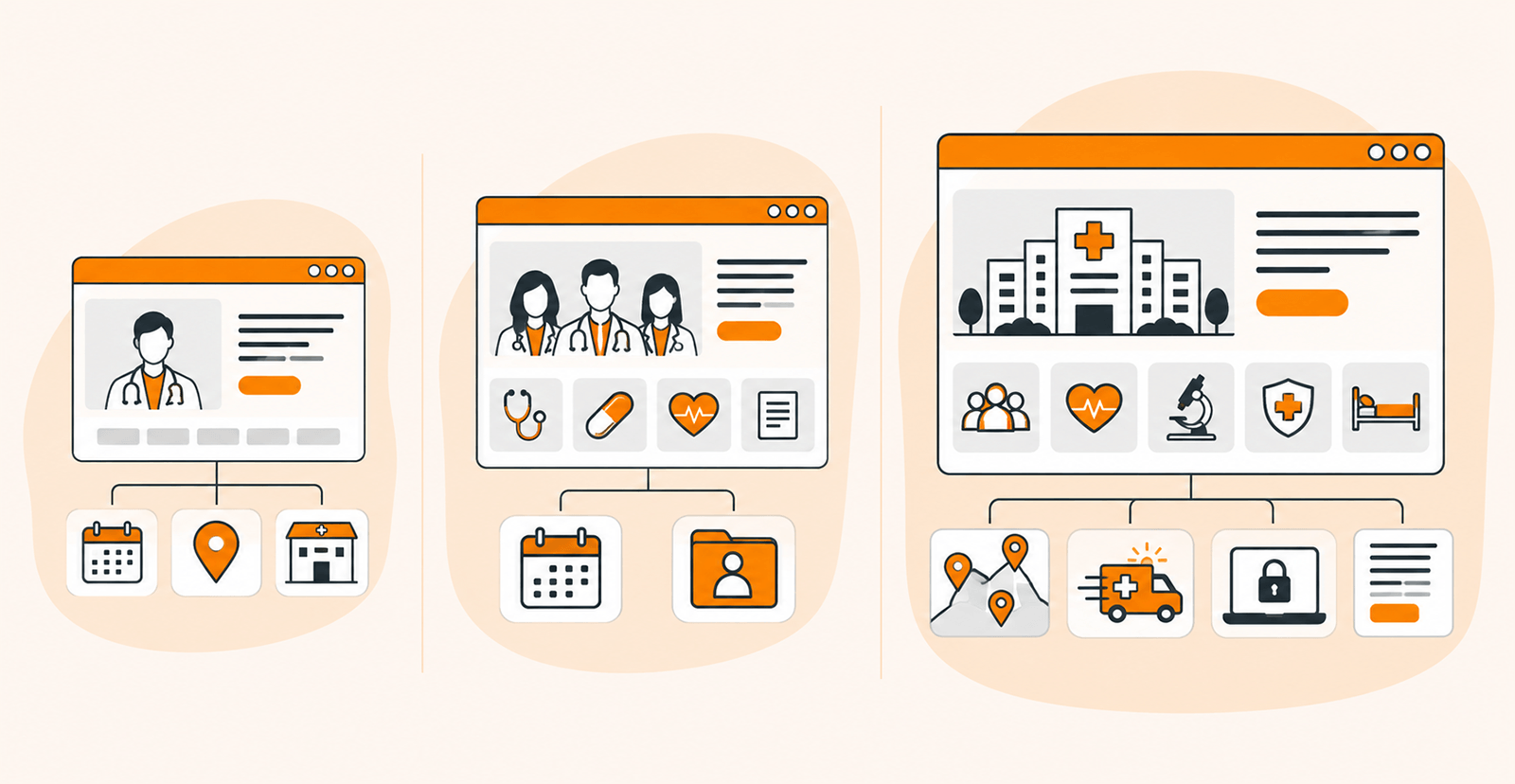
- Website scope should match organizational complexity: 5 to 15 pages for a private practice, 15 to 40 for a clinic, and 50 to 500+ for a hospital system with multiple departments and locations.
A healthcare website is often the first place patients go when they want to learn about a doctor, explore a treatment, find a nearby clinic, or schedule an appointment. It is not a digital brochure. It is a functional tool that needs to help patients complete real tasks: finding the right provider, understanding a treatment, booking a visit, and accessing their health records.
In 2026, an effective healthcare website combines patient-centered design with online scheduling, provider directories, patient portals, mobile responsiveness, accessibility compliance, HIPAA-aligned security, and search visibility. This guide covers the essential features, design principles, compliance requirements, and SEO strategies that healthcare organizations need to build a website that serves both patients and the business, whether you run a private practice, a multi-provider clinic, or a hospital system.
What Makes a Healthcare Website Different?
Healthcare websites have different requirements from standard business websites. This is because patients may use them to find urgent information or make important decisions about their health. So, a healthcare website must prioritize:
- Clear and reliable information that is well organized so that patients can find what they need without any hassle
- Specific features such as appointment booking, patient portals, and provider directories
- Privacy and security to handle sensitive information
- An easy-to-navigate website for patients of all ages
- Mobile responsiveness, since many patients use smartphones to access healthcare websites
Essential Features of a Healthcare Website in 2026
A healthcare website should be designed to make common patient tasks as simple as possible. The functionality a website needs depends on the organization, but several features have become increasingly important.
Mobile-First, Patient-Centered Navigation
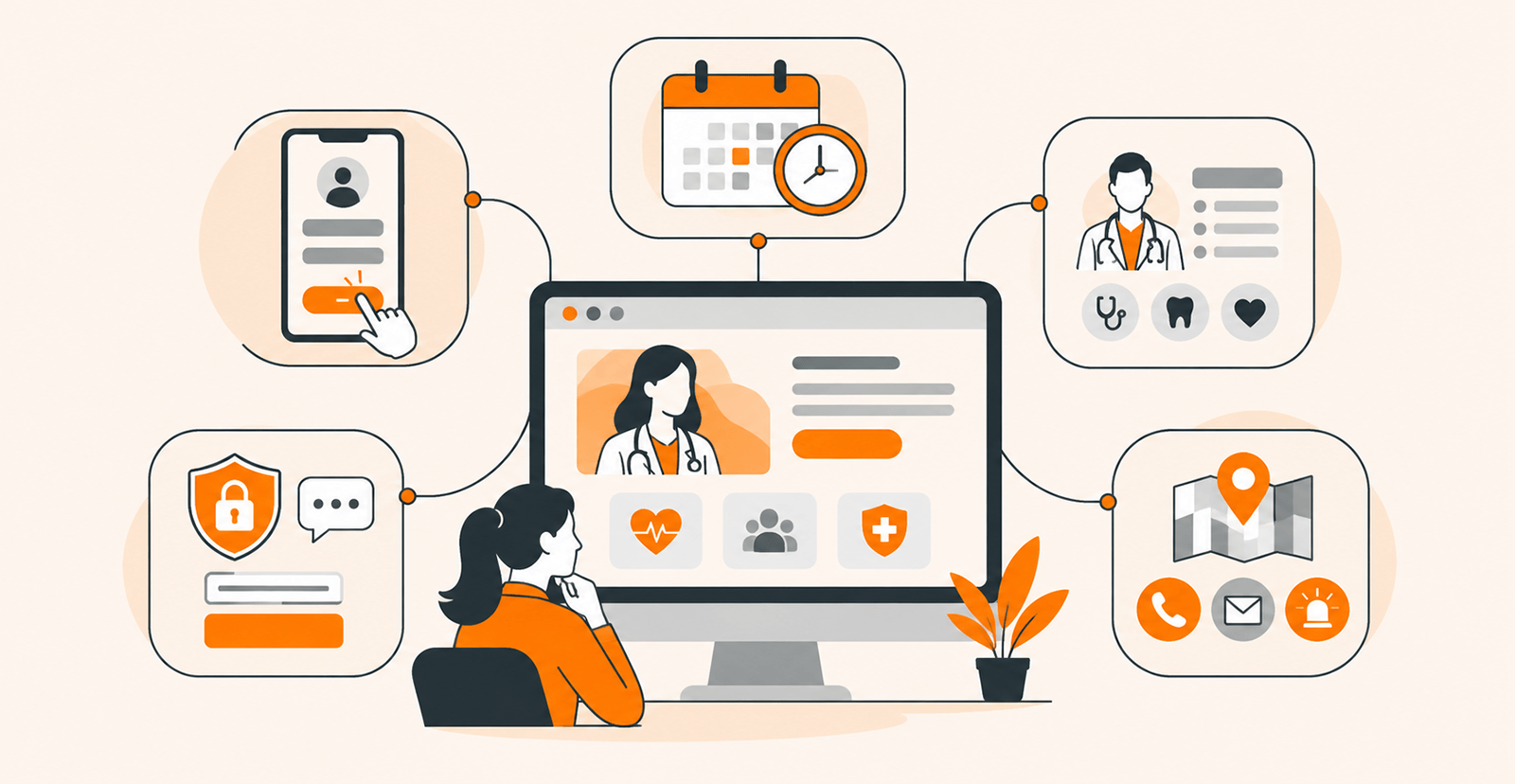
A mobile-first approach ensures that patients can easily access information, regardless of the device they use. Navigation should not be complex. Prominent calls to action, such as ‘Find a Doctor,’ ‘Book an Appointment,’ and ‘Contact Us,’ should be easy to locate. This helps users quickly identify the next step, whether that means finding a doctor, booking an appointment, or contacting the practice.
The design should maintain a clear visual hierarchy, readable typography, and consistent navigation across all pages.
Online Appointment Scheduling
Online appointment scheduling is one of the most useful features a healthcare website can offer. It allows patients to check availability and book an appointment at a convenient time. By simplifying the appointment process, healthcare organizations can reduce administrative workload and support a consistent internal workflow.
For healthcare organizations, scheduling is more complex than a simple calendar booking. Different providers may have different availability rules, new patients may need longer appointment slots than returning patients, and some specialties require referrals or prior authorization before booking. The scheduling system should reflect these clinical realities rather than forcing all appointment types into the same flow.
Provider Profiles and Medical Services
Before booking, patients often want to know more about the healthcare provider they are scheduled to visit. A dedicated provider profile should include the provider’s qualifications, specialty, years of experience, and other relevant information.
Healthcare organizations should also create clear, dedicated pages for their services and treatments. This helps patients understand which services are relevant to their needs and what the treatment process involves without unnecessary medical terminology.
For organizations with multiple providers in the same specialty, profiles should help patients distinguish between subspecialists. A cardiology department may include electrophysiologists, interventional cardiologists, and heart-failure specialists, each treating different conditions. Profiles that only list board certification and medical school don't help patients identify the right provider for their specific need.
Patient Portals and Digital Communication
A dedicated patient portal can give patients easy access to appointments, forms, test records, and other digital resources. These features should be easy to find. Sensitive information must be handled through secure, compliant systems. The goal is to create a website that provides a clear entry point to healthcare services without compromising patient privacy.
The portal entry point should be clearly separated from the public-facing website. Patients accessing lab results or messaging their provider need a direct, secure path. Burying the portal login inside a general navigation menu creates friction for returning patients who visit the site specifically for portal access.
Location, Contact, and Emergency Information
Basic contact details, including phone numbers, addresses, locations, and opening hours, should be easy to find. Emergency services, urgent appointment information, and other time-sensitive resources should be particularly prominent. Clear information can help patients understand what to do, whom to contact, and when to seek immediate medical assistance.
How Healthcare Website Design Creates a Better Patient Experience
A healthcare website is only effective if patients can complete basic tasks without difficulty. Visual appeal matters, but usability comes first.
Some ways to improve the website’s UX include:
- Keep it simple: Users should be able to find and understand information about a particular service without going through unnecessary steps. To achieve this, avoid a long menu and excessive pop-ups.
- Prioritize readability: Clear and straightforward headings, readable fonts, and well-spaced layouts make content easier to understand. This is particularly helpful for older patients with cognitive, motor, or visual disabilities.
- Focus on speed and performance: Users can get frustrated with slow-loading pages. This is especially problematic when they need urgent information. To give them a smoother experience, use efficient code, reliable hosting, and optimized images.
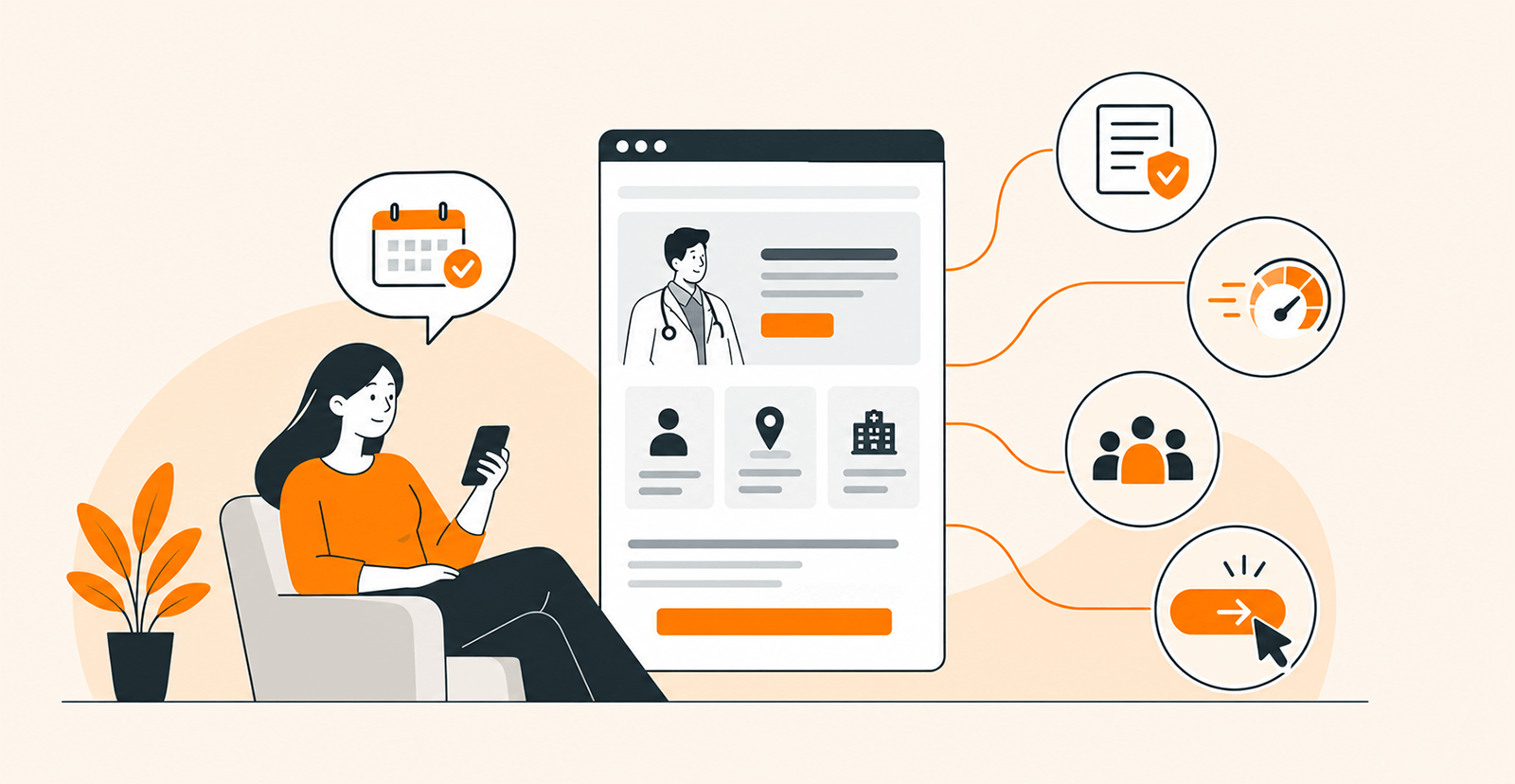
- Add clear CTAs: Healthcare websites need to guide users toward a relevant next step. This could be scheduling an appointment, contacting a clinic, finding a provider, or gathering information about a treatment.
Accessibility, Security, and Compliance in Healthcare Website Design
Healthcare websites serve a diverse audience, and healthcare organizations may handle sensitive patient information through them.
Accessibility
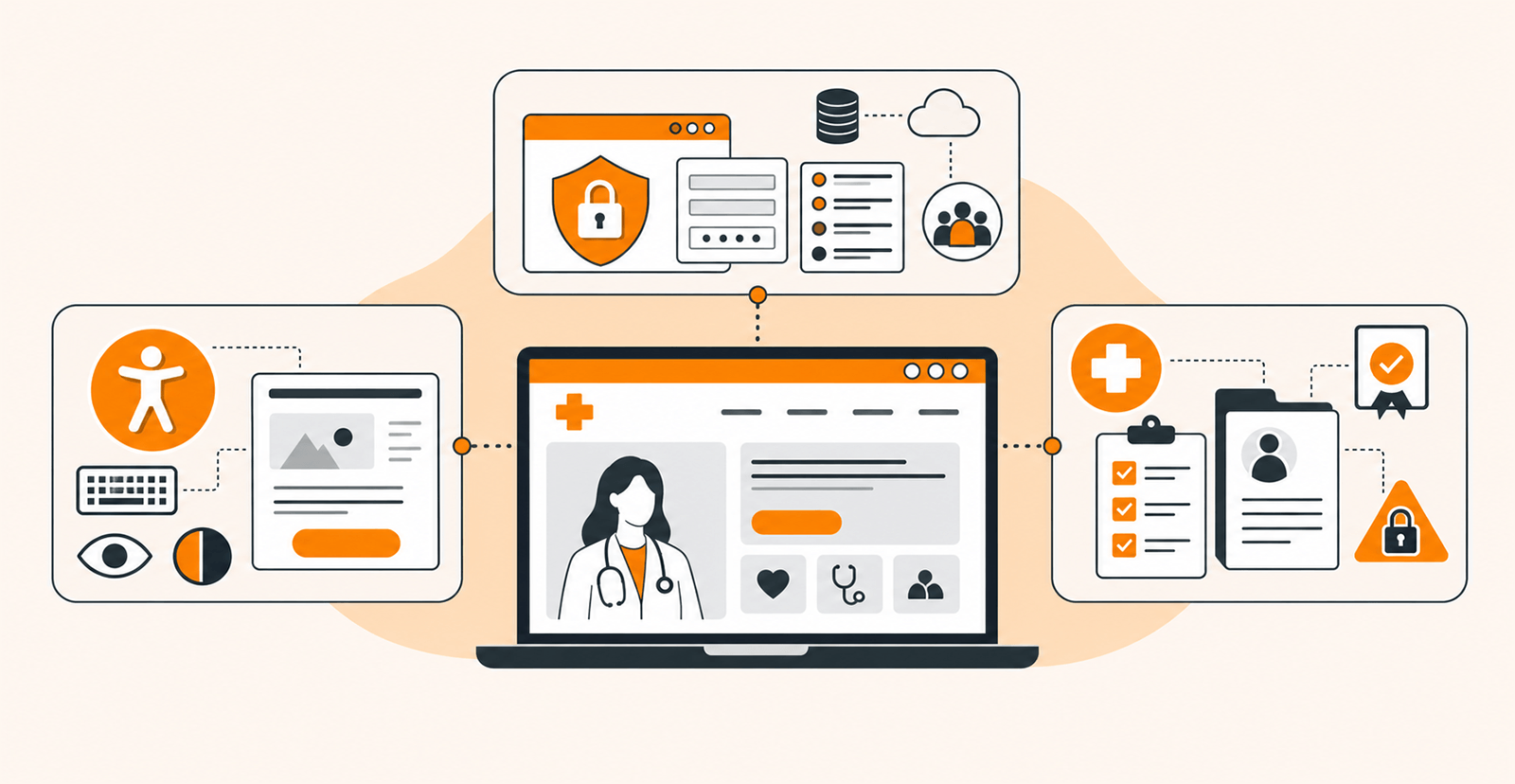
An accessible website allows more people to access and use its content. Accessibility depends on both clear design and effective functionality. The design should follow recognized accessibility principles, including sufficient color contrast, keyboard-friendly navigation, captions where necessary, and properly structured content.
Accessibility can make a website easier to use for everyone, especially those who may have difficulty distinguishing colors, reading small text, or navigating complex interfaces. WCAG 2.2 provides the most widely used technical framework for web accessibility. For US healthcare organizations receiving federal funding, Section 504 of the Rehabilitation Act may also apply, with enforcement by HHS's Office for Civil Rights. Building accessibility into components during development is more effective and less expensive than auditing and remediating after launch.
Privacy and Security
Healthcare organizations that collect or transmit Protected Health Information (PHI) through their websites must implement appropriate safeguards. This includes secure form handling, encrypted data transmission (HTTPS), access controls, authentication, audit logging, and secure integrations with scheduling, EHR, and patient portal systems. Vendors that handle PHI on behalf of the organization may need to sign Business Associate Agreements (BAAs).
Healthcare Compliance
In the US, HIPAA's Privacy, Security, and Breach Notification Rules govern how PHI is collected, stored, accessed, and shared. This becomes relevant when the website includes appointment forms, patient intake, symptom information, or integrations with systems that process PHI. Compliance requirements should be addressed during the design and development phase, not retrofitted after launch.
Healthcare SEO in 2026: Helping Patients Find Your Website
A well-designed healthcare website delivers greater value when patients can easily find it. Healthcare SEO helps practices, clinics, and hospitals improve their visibility when people search for relevant services, providers, and locations. In 2026, an effective healthcare SEO strategy should focus on:
- Service and treatment pages: Create dedicated pages for important services, treatments, and specialties. Each page should address common patient questions and use clear, descriptive headings and titles. Each condition, treatment, and specialty should have its own dedicated page rather than being combined into a single services overview. Separate pages allow search engines to match specific patient queries to specific content, and they provide better internal linking opportunities across conditions, treatments, providers, and locations.
- Local SEO: Optimize location pages and maintain accurate business information, including addresses, phone numbers, operating hours, and service areas, to help nearby patients find the organization. For multi-location organizations, each location should have a unique page with its own address, hours, providers, services, and contact information. Avoid creating near-identical pages for each location by including location-specific content. Connect each location page to relevant provider profiles and service pages.
- Helpful and credible content: Healthcare content should provide accurate, useful, and patient-focused information while demonstrating the organization's expertise and credibility.
- Technical SEO: Mobile responsiveness, page speed, crawlability, metadata, internal linking, and structured data can help search engines understand and index the website more effectively.
- Patient-focused search intent: Instead of optimizing only for keywords, consider what patients are actually trying to accomplish, whether they are looking for a specialist, comparing treatments, finding a location, or booking an appointment.
The objective is not simply to attract more traffic. Effective healthcare SEO should bring the right visitors to the right pages and help them take an appropriate next step toward care.
How Healthcare Website Design Should Differ by Organization
Healthcare website design should reflect the size, services, and operational complexity of the organization. A small medical practice does not need the same website architecture as a large hospital. Therefore, the right approach is to build the website around the organization's specific patient journeys rather than relying on a one-size-fits-all template.
Healthcare Organization | Key Website Priorities | Typical Content Scope |
Private Practice | Provider profile, services, appointment booking, local SEO, contact information | 5-15 pages |
Clinic | Multiple providers, specialties, service pages, scheduling, patient resources | 15-40 pages |
Hospital | Departments, specialists, multiple locations, emergency information, patient portals, complex navigation | 50-500+ pages |
However, creating an effective healthcare website requires all these elements to work together. Quixta combines patient-centered design with search visibility, secure development, and scalable functionality. Together, these elements help healthcare organizations create more effective digital experiences.
Why Choose Quixta for Healthcare Website Design?
Building a healthcare website requires more than selecting a template and adding information. The design needs to bring together patient experience, business objectives, functionality, performance, and scalability. Quixta approaches healthcare website design with these considerations in mind, focusing on creating digital experiences that serve both organizations and their patients.
- Patient-centered UX: Our websites are structured around patient journeys, making it easier for users to find services, providers, and important information. Clear navigation, logical page structures, and prominent calls to action can make key interactions easier for patients. This helps visitors move from finding information to taking action, such as booking an appointment or contacting a provider.
- Responsive website design: Interfaces are designed to provide a consistent experience across desktops, tablets, and mobile devices. This is particularly important because patients often use smartphones to search for healthcare services and information. A responsive layout ensures that content, navigation, forms, and calls to action remain easy to use on different screen sizes.
- SEO-friendly development: Website structure and content are carefully planned to support search visibility and help patients discover relevant services online. This includes organizing service pages, provider information, location pages, and other important content in a search-friendly structure. Clean development also gives future SEO campaigns a stronger foundation.
- Scalable development: We build websites that can grow alongside the organization, allowing them to expand their services, functionality, and digital capabilities over time. A growing clinic, for example, may need to add new providers, locations, or services without rebuilding the website from scratch. Planning for scalability from the beginning can make future updates more manageable.
- Performance-focused design: Fast loading times, streamlined navigation, and efficient website architecture can contribute to a smoother patient experience. Visitors may leave a website if pages take too long to load or navigating between them becomes difficult. Faster pages improve both usability and search performance.
Conclusion
Healthcare website design in 2026 must deliver on what patients expect: ease of use, accessibility, and trust. Features like mobile-first navigation, online scheduling, provider information, patient portals, accessibility, security, compliance, and SEO all contribute to a website that serves both patients and healthcare organizations.
Whether you are building a website for a private practice, clinic, or hospital, the best approach starts with understanding your users and designing around their needs. A patient-centered, secure, accessible, and scalable website can become an important part of how your organization connects with the people it serves.
Need a Healthcare Website Built for Patients and Performance?
Quixta designs and develops healthcare websites for private practices, clinics, and hospital systems. Every build is structured around real patient journeys, with mobile-first navigation, online scheduling, provider directories, accessibility compliance, secure form handling, and SEO-friendly architecture included from day one.
Whether you are launching a new practice website, redesigning an existing one, or scaling a multi-location hospital platform, we scope every project around your organization's size, services, and compliance requirements.
FAQs
A healthcare website should include important elements such as clear navigation, provider profiles, service and treatment pages, and online appointment scheduling. Patients should also be able to find contact details, locations, operating hours, and emergency information without difficulty. The website should also be responsive so patients can access it easily across different devices. However, the exact features will depend on whether the website is being built for a private practice, clinic, or hospital.
Mobile-first design ensures that patients can access important healthcare information regardless of the device they use. Many users rely on smartphones when searching for doctors, treatments, healthcare facilities, and appointment information. A responsive website should keep its navigation, content, forms, and calls to action easy to use on smaller screens. This approach can therefore support both patient satisfaction and website usability.
Healthcare website design can improve the patient experience by making information and common tasks easier to access. Features such as online appointment scheduling can also simplify the process of connecting with a healthcare provider. Fast-loading pages can reduce frustration, particularly when patients need important information quickly. Clear calls to action can guide visitors toward appropriate next steps, such as booking an appointment or contacting the clinic. Overall, a patient-centered design should make it easier for patients to find information and complete key tasks.
An accessible healthcare website is designed so that people with different abilities can use its content and functionality effectively. Content should be organized with clear headings and a logical structure so users can understand and navigate it more easily. Accessible design can also benefit older patients and people who have difficulty reading small text, distinguishing colors, or navigating complex interfaces. Following recognized accessibility principles during development can therefore create a more inclusive healthcare website.
Healthcare websites that collect patient information through forms, scheduling systems, or portal access need appropriate security measures to protect that data. Patient information should not be collected through insecure or inappropriate forms. Building security into the website from the planning stage can help reduce potential risks later in the development process. Healthcare organizations should also assess the privacy and compliance requirements that apply to their specific operations.
Healthcare SEO helps practices, clinics, and hospitals become more visible when people search for relevant healthcare services, providers, treatments, and locations. Dedicated pages for services, specialties, treatments, and locations can help search engines understand what the organization offers. The website should also demonstrate expertise and credibility when publishing healthcare-related information. Ultimately, effective SEO should attract relevant visitors and guide them toward useful pages and next steps.
The design of a healthcare website should reflect the organization's size, services, and operational complexity. A private practice may primarily need provider information, service pages, appointment booking, contact details, and local SEO. A clinic may require more complex navigation because it can have multiple providers, specialties, services, and patient resources. Hospitals typically need a broader website structure covering departments, specialists, multiple locations, emergency information, and patient portals. The number and type of website features should therefore be determined by the organization's actual patient journeys.
Online appointment scheduling gives patients a convenient way to check availability and book appointments without relying entirely on phone calls. Moreover, the booking feature should be easy to find and simple to use across desktop and mobile devices. Depending on the organization, scheduling functionality may also be connected to existing healthcare or practice-management systems. By reducing friction in the booking process, online scheduling can improve convenience for both patients and healthcare staff.
Provider profiles help patients understand who will be providing their care before they schedule an appointment. A useful profile can include a provider's qualifications, specialty, years of experience, areas of expertise, and other relevant information. This information can help patients determine whether a provider is suitable for their needs. Well-organized provider information can contribute to a more transparent and patient-focused website experience and help search engines understand the healthcare professionals and specialties associated with the organization.
Custom healthcare website design and development allows an organization to build its digital experience around its specific patients, services, and operational requirements. A private practice, multi-specialty clinic, and hospital may all require different website structures and functionality. A custom approach can incorporate patient-centered UX, responsive design, SEO-friendly structures, and performance considerations from the beginning. This can make the website easier to adapt as the organization grows.
