
TLDR
- The most common problems with the wrong Webflow agency are unmanageable class structures, CMS architectures that break when content grows, SEO treated as a post-launch task, and no support after delivery.
- Evaluate an agency by inspecting live sites (not just screenshots), asking for read-only Designer links, and questioning their class-naming methodology, CMS architecture approach, and SEO process during development.
- Webflow development agencies in India typically charge ₹2,000 to ₹8,000/hr for hourly work, ₹75,000 to ₹25,00,000+ for fixed-price projects, and ₹20,000 to ₹1,50,000/month for retainers. Always compare deliverables and scope, not headline totals.
- You need an agency when the project involves 20+ dynamic pages, a platform migration, third-party integrations, or a site that directly drives leads or revenue. Simple 5 to 8 page static sites can often be built in-house.
- A quote that excludes CMS setup, SEO, accessibility, content migration, or post-launch support can add 20 to 40% to the real cost. Ask for a line-item breakdown before comparing proposals.
Webflow has transformed from a niche site-building visual editor into a platform used by organizations of all sizes. Webflow has grown from a niche visual editor into a platform used by organizations of all sizes, with adoption rates climbing steadily among higher-traffic websites. This growing confidence in Webflow for advanced digital experiences means more businesses need specialized agencies to build on the platform properly.
Choosing Webflow is just the first step. Whether your website will succeed greatly depends on which agency you choose. Too often, businesses select an agency based on price alone, which leads to slow delivery, poor scalability, weak SEO implementation, or no support after launch. Choosing a highly qualified Webflow agency involves strategy, experience, and a development process that can help to save you time and money in the long run.
This guide covers the criteria for choosing the right Webflow development agency in India, from evaluating expertise to understanding pricing models.
Why Choosing the Right Webflow Development Agency in India Matters
Webflow combines visual development, CMS, hosting, interactions, and SEO tools into a single platform. That makes it powerful, but it also means the agency building your site needs to understand all of these layers, not just visual design. A developer who treats Webflow like a drag-and-drop builder will produce a site that looks finished but falls apart the moment your team tries to scale it.

Here's what typically goes wrong with the wrong agency.
The class structure becomes unmanageable
Without a deliberate naming system like Client-First or a comparable methodology, the project accumulates hundreds of disorganized classes. Adding a new page becomes unpredictable because no one knows which class controls what. Your team ends up duplicating sections instead of reusing Components, and every update takes longer than it should.
The CMS is built for today but breaks tomorrow
A common shortcut is building Collections around the pages that exist at launch. This works until the business adds new services, case studies, or resources. If the Collections and Reference fields weren't planned for growth, your marketing team hits a wall, and the site needs a rebuild far sooner than expected.
SEO is treated as a post-launch task
URL structure, heading hierarchy, internal linking, sitemap configuration, and schema markup need to happen during development. An agency that plans to "add SEO later" will deliver a site that's harder and more expensive to optimize afterward.
Performance degrades from the start
Unoptimized images, excessive custom code, and heavy third-party scripts slow the site down. If the agency doesn't test Core Web Vitals during development, you inherit performance problems on launch day. Fixing them afterward often means paying twice.
Post-launch support doesn't exist
Some agencies deliver the project and move on. Without ongoing support for CMS updates, bug fixes, and performance monitoring, the site slowly deteriorates until it needs a full overhaul.
How To Evaluate a Webflow Development Agency in India
Choosing a Webflow agency based on a polished website or a competitive quote isn't enough. The evaluation needs to go deeper, into how the agency actually builds, what their projects look like under the surface, and whether their process supports your business beyond launch.
Evaluate Their Webflow Technical Expertise
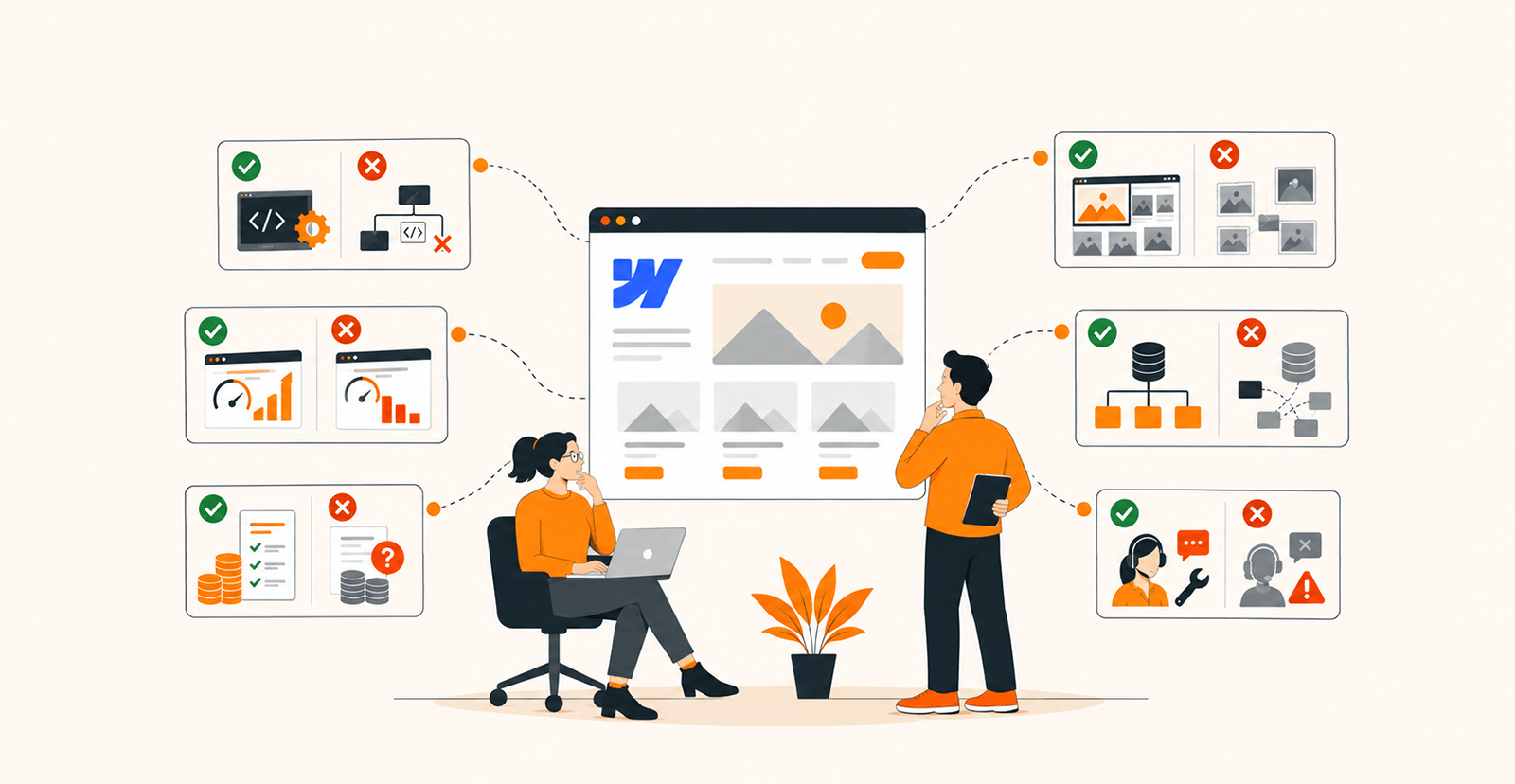
The agency should be able to explain how they structure a project before they start designing it. This means having a clear class-naming methodology, a defined strategy for using Webflow Variables and Component Properties, and an understanding of how to build CMS architectures that scale.
Red flag: The agency can't explain their class-naming approach or treats Webflow as a visual tool while relying heavily on custom code for features Webflow handles natively.
Ask them: What class-naming system do you follow? How do you use Variables and Component Properties? Can you walk me through the CMS architecture of a recent 30+ page project?
Inspect Their Portfolio Beyond the Surface
Open live sites from their portfolio. Check page speed using Google PageSpeed Insights. View them on mobile. Navigate CMS-driven pages like blogs, case studies, and team directories to see whether the content structure is consistent or fragmented.
If possible, ask for a read-only Designer link so you can inspect class organization, Component reuse, and Collection structure. A clean project in the Designer tells you more about quality than any case study page.
Red flag: The portfolio only shows screenshots or mockups, not live sites. Live sites are slow, broken on mobile, or visually inconsistent across pages.
Ask them: Can I see a live project from the last six months? Can you share a read-only link to review the project structure?
Assess Their SEO Approach During Development
SEO in Webflow isn't about entering meta titles after launch. It's about decisions made during the build: URL structure, heading hierarchy across templates, internal linking between related content, XML sitemap configuration, schema markup, and image optimization.
A strong agency builds the site architecture around target keywords and search intent before designing the first page. They structure Collection pages so content has distinct, crawlable URLs and implement structured data at the template level.
Red flag: The agency lists "SEO" as a service but can't explain their approach to site architecture or internal linking. They treat SEO as metadata entry only.
Ask them: How do you decide URL structure for CMS pages? Do you implement schema markup, and at what stage? How do you handle canonical tags for larger sites?
Review Their CMS Architecture Approach
Webflow's CMS is where inexperienced agencies create the most long-term problems. A well-built CMS uses Collections, Reference fields, and Multi-Reference fields to create content relationships that scale. A poorly built CMS stores everything in flat Collections with no relationships, forcing your team to duplicate content and manage updates manually.
For a site with services, case studies, and team members, the CMS should connect case studies to relevant services and team members rather than storing them as isolated entries.
Red flag: The agency builds Collections without Reference fields, creates static pages for content that should be dynamic, or can't explain how they'd handle a client adding 50 new items to a Collection.
Ask them: How do you structure Collections for a site with multiple content types? What's your approach when content needs grow beyond initial scope?
Verify Transparent Pricing
A professional agency will break down the quote into specific deliverables: discovery, UI/UX design, development, CMS setup, content migration, SEO, QA, launch, and post-launch support. Pay close attention to what's excluded. Content creation, photography, integrations, accessibility testing, and ongoing maintenance are commonly left out and can add 20-40% to the total cost.
Red flag: The agency quotes a single price with no breakdown. The price is significantly below market rate without a clear explanation of scope.
Ask them: Can you provide a line-item breakdown? What's excluded? How do you handle scope changes during the project?
Check Post-Launch Support
Webflow doesn't need the constant plugin updates WordPress demands, but sites still need ongoing attention: content updates, performance monitoring, bug fixes, and platform changes. If the agency doesn't offer structured post-launch support, you'll be searching for a new partner within months.
Red flag: No retainer offering, no defined response times, or former clients reporting difficulty getting help after launch.
Ask them: What does post-launch support include? What's the response time for fixes vs. content requests? Can I speak with a current retainer client?
When Should You Hire a Webflow Development Agency?
Not every Webflow project needs an agency. A simple 5- to 8-page site with no CMS, no integrations, and a straightforward layout can often be built in-house using Webflow's templates and documentation. An agency becomes the right choice when the stakes are higher. Here's when it makes sense to bring one in.
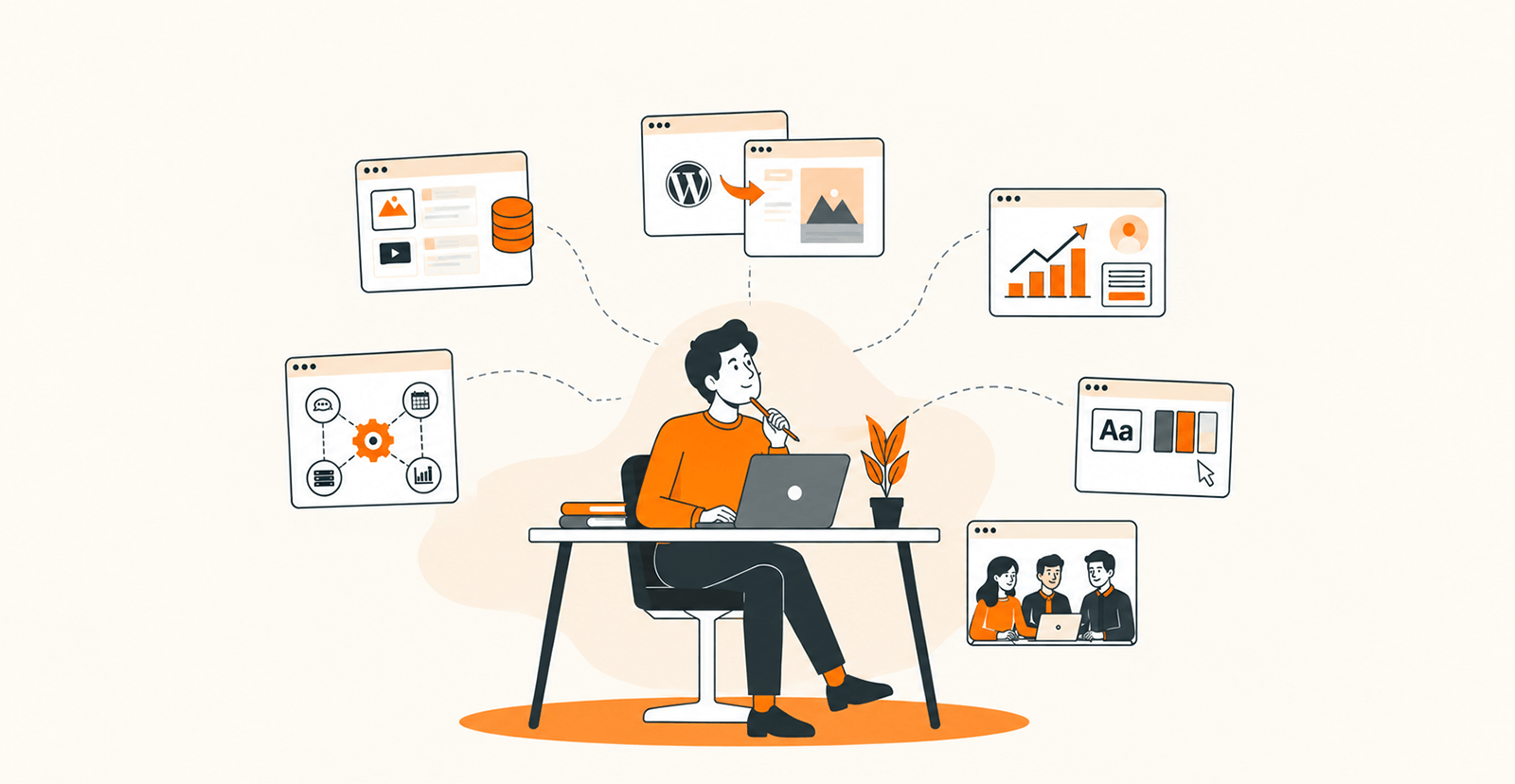
- Your site needs CMS architecture that scales: If the project involves 20+ pages of dynamic content like blogs, case studies, services, or team directories, the CMS Collections, Reference fields, and content relationships need to be planned by someone who's done it before.
- You're migrating from another platform: Moving from WordPress or another CMS to Webflow requires URL mapping, 301 redirects, content migration, and SEO preservation. One missed redirect can wipe out years of organic visibility.
- The website drives leads or revenue directly: A SaaS marketing site generating signups or a healthcare platform driving patient appointments has a high cost of failure. Match the agency investment to what's at stake if the site underperforms.
- You need third-party integrations: Connecting Webflow to CRMs, scheduling systems, analytics platforms, or payment tools requires API knowledge and testing that goes beyond visual development.
- Your team knows design but not Webflow specifically: Webflow's interface looks approachable, but building a scalable, maintainable site requires understanding class architecture, CMS modeling, performance optimization, and SEO structure. An experienced Webflow development agency in India can deliver a project that works on launch day and stays manageable as the business grows.
- You need a custom design system across multiple page types: If the site requires consistent components, Variables, and design tokens across dozens of templates, an agency with a documented build methodology will save you months of rework.
How Much Do Webflow Development Agencies in India Charge?
Most Webflow agencies in India use one of four pricing models. Understanding them helps you compare proposals accurately and spot when a quote is missing important scope.
Pricing Model | Estimated Cost (INR) | Estimated Cost (USD) | What's Included | Best For |
Hourly Rate | ₹2,000–₹8,000/hr | ~$25–$95/hr | Development, minor changes, CMS updates | Small updates, bug fixes |
Fixed-Price Project | ₹75,000–₹25,00,000+ | ~$900–$30,000+ | Discovery, UI/UX, development, QA, launch | Defined project scope |
Monthly Retainer | ₹20,000–₹1,50,000/mo | ~$240–$1,800/mo | Content updates, maintenance, SEO, monitoring | Ongoing management |
Dedicated Team | ₹1,50,000–₹6,00,000+/mo | ~$1,800–$7,200+/mo | Designer(s), developer(s), PM, continuous work | Large/enterprise projects |
USD estimates are approximate and may vary with exchange rates.
Actual pricing depends on project complexity, agency experience, number of custom pages and CMS Collections, integrations, content volume, and whether the scope includes SEO, accessibility, and post-launch support.
When comparing quotes, keep three things in mind. First, a ₹1,50,000 quote and a ₹5,00,000 quote for the same project aren't necessarily competing on the same scope. The lower quote may exclude CMS architecture, SEO, or post-launch support. Always compare deliverables, not totals. Second, fixed-price projects work well when requirements are clear before development starts. If scope is likely to evolve, a retainer or phased approach gives more flexibility. Third, retainer models are worth considering if the website needs regular content updates, performance monitoring, or iterative improvements. Monthly retainers are often more cost-effective than ad-hoc hourly requests.
Conclusion
Choosing the right Webflow development agency in India is about finding a technology partner, not just a service provider. Evaluate their Webflow expertise through live projects, not just portfolios. Ask about their CMS architecture approach, SEO methodology, and class-naming conventions. Compare proposals by deliverables and scope, not just price. And confirm what happens after launch, because a website that isn't maintained will degrade regardless of how well it was built.
Ready to Build a High-Performing Webflow Website?
Quixta is a Webflow development agency based in Bangalore with 8+ years of delivery experience across 480+ projects. We build scalable Webflow websites with structured CMS architecture, technical SEO, and ongoing support. If you need a new build, a redesign, or a migration from WordPress, we can scope it.
FAQs
When hiring the best web development company, you should consider more than just cost. An ideal Webflow development agency has strong experience with Webflow, a solid portfolio, good customer reviews, and industry expertise. You should inquire about the agency's design and development methodology, SEO skills, communication skills, and post-development process. You should also prefer an agency that provides transparency in costing and project timelines.
The cost of web development varies according to the size and nature of your project, as well as the pricing plan offered by the company. Hourly pricing usually ranges from ₹2,000 to ₹8,000 per hour. Fixed pricing plans vary between ₹75,000 and ₹25,00,000 or more. For businesses that need regular website updates, retainer plans can be chosen starting from ₹20,000 to ₹1,50,000 per month. For large firms, a Webflow team monthly could cost you around ₹1,50,000 to ₹6,00,000+ per month.
Yes. The platform is flexible enough to serve both small businesses and enterprises. The former gets features such as content management, responsive design, and reduced maintenance effort; the latter can take advantage of the CMS, integration capabilities, scalability, and security provided by hosting services. Irrespective of whether you need a five-page site or a complex enterprise platform, Webflow will always prove to be flexible enough to meet your demands.
Yes. However, it is only possible if the agency you hire has the necessary expertise in Webflow. Such an agency will be able to transfer your site in a way that does not damage SEO. This means that your content will be moved to your new site, pages will be recreated, proper 301 redirects will be created, metadata will be preserved, and URL structure will be optimized.
Apart from appealing visual designs, your portfolio should also show whether the websites are responsive, fast-loading, and user-friendly. Look for projects involving CMS building, interactive features, SEO optimization, and industry websites. You can check how the websites function by looking at live projects instead of screenshots only.
Depending on the level of complexity and size of the website, the duration of Webflow projects differs. For instance, a landing page may take one or two weeks, whereas developing a regular business website can take many weeks. Advanced projects such as CMS building, integrations, and enterprise-level projects can take several months. In the discovery process, your agency should discuss the timeline and milestones.
Unlike traditional CMS websites that require constant user maintenance, Webflow requires little ongoing upkeep, as hosting, security, and platform updates happen automatically. Nevertheless, it will be useful for the business to perform frequent content updates, monitor the website's performance, fix any bugs, and work on SEO. Agencies usually provide maintenance services that can keep websites up to date, safe, and well-performing.
Yes, you surely can. One of the greatest benefits of the Webflow website is its intuitive CMS, which enables users to update blogs, case studies, landing pages, staff pages, and other elements of the website easily without any coding. Moreover, many Webflow agencies offer CMS training services right after the website launch. This means your marketing department can manage content independently.
The cheapest option is not necessarily the most cost-effective option. Agencies offering significantly lower prices may be cutting corners on design quality, SEO, testing, documentation, or post-launch support. All of these could eventually result in extra costs for fixing bugs, redesigning the website, and optimizing it in the future. It is recommended to base the decision on experience, communication, portfolio, and more than just pricing.
A complete Webflow agency should offer comprehensive services such as strategy, UI/UX Design, Custom Webflow Development, Content Management System Implementation, technical SEO, performance optimization, website migration, testing, deployment, and post-launch maintenance. Some companies offer additional services such as conversion optimization, analytics integration, and website optimization.